

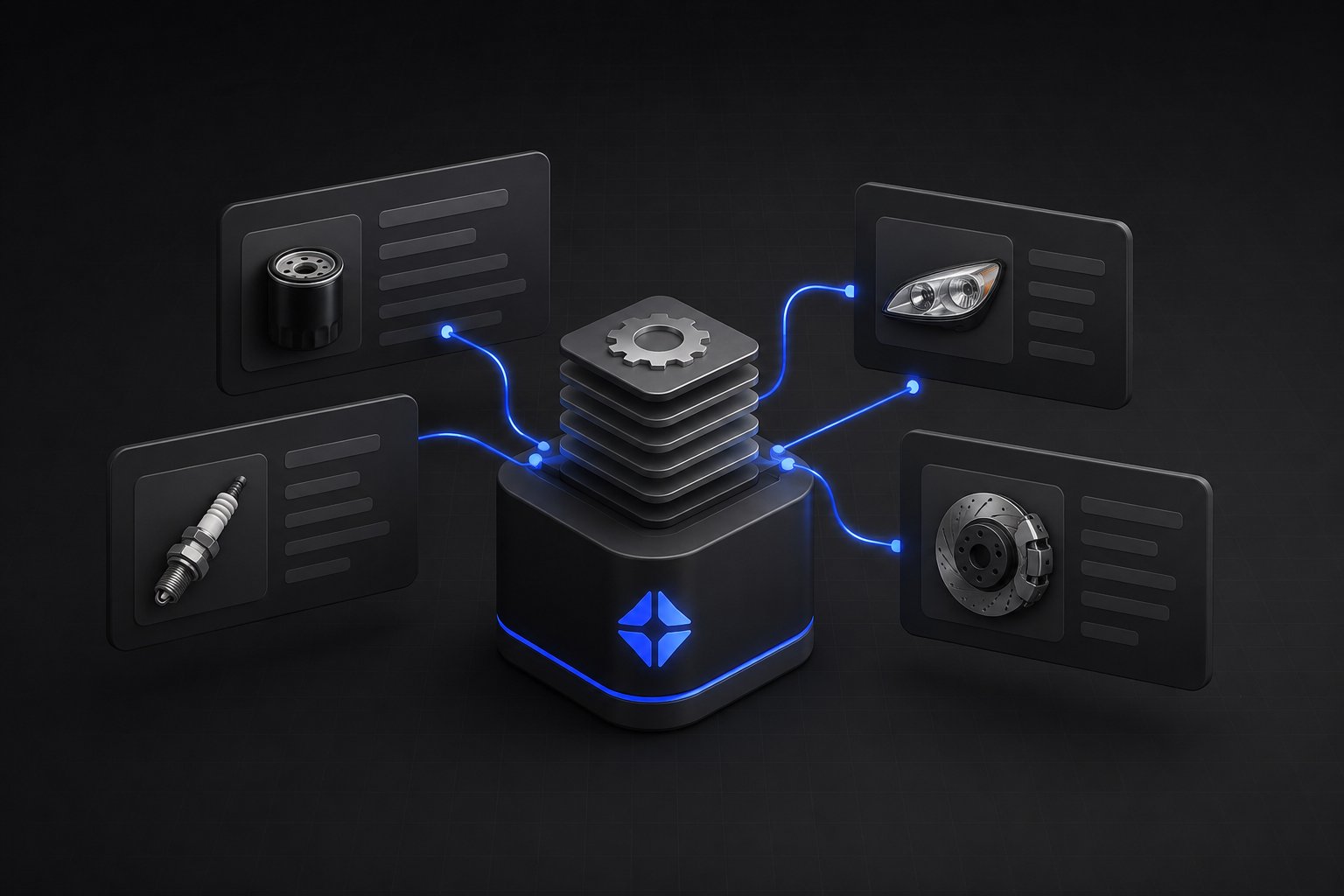
A parts buyer rarely arrives with your SKU. They arrive with a number: the OEM number off the old part, a competitor's number from the box in their hand, or a number that was superseded two catalog updates ago. What your store does with that number decides the sale.
Resolve it to the right part and the order happens. Return "no results" for a part you actually stock, and the buyer concludes you do not carry it. Resolve it to the wrong part, and you have bought a return and lost some trust.
Quick answer: Parts cross-reference data, also called interchange data, maps equivalent part numbers to each other: OEM numbers to aftermarket replacements, competitor numbers to your SKUs, and old superseded numbers to their current versions. An aftermarket catalog needs these mappings maintained alongside its fitment data, because a number that fails to resolve is a lost sale and a number that resolves wrong is a wrong-part order. Cross-references are catalog infrastructure, not a lookup convenience, and adding part number lookup or fitment search to a Shopify store is first a data project and only then an app decision.
What Cross-Reference Data Actually Is
A cross-reference, or interchange, is a stated equivalence between part numbers. As Hedges & Company puts it, an interchange part number shows that an aftermarket or remanufactured part is compatible with the original OEM factory part. That is the most familiar type, but a working catalog carries three distinct kinds of mapping.
OEM-to-aftermarket. The buyer has the factory number from the part they are replacing. The catalog resolves it to your aftermarket equivalents. This is the highest-intent search a parts store receives: the buyer has already done the identification work and just needs the match.
Brand-to-brand. The buyer knows the part as a competitor's number, a Bosch filter number, a Gates belt number, and your store carries the equivalent under a different brand. Without this mapping, you lose sales to whoever's number the buyer happens to know.
Supersession chains. Manufacturers replace part numbers over time: a number is discontinued and superseded by a new one, which may later be superseded again. A catalog that does not follow the chain leaves buyers searching for a number that was valid when they last ordered and now resolves to nothing.
Why Catalogs Break Without It
The failure modes are quiet, which is what makes them expensive.
A search that returns nothing does not generate a support ticket. The buyer assumes you do not stock the part and leaves, and the analytics show it as just another zero-result search. For a distributor whose buyers are repair shops ordering against an OEM number all day, unresolved numbers are a steady leak of exactly the highest-intent traffic the store gets.
The wrong-mapping case is louder. A cross-reference that points to a near-match instead of a true equivalent produces an order, a shipment, an installation attempt, and a return, with the buyer holding you responsible, reasonably, since your catalog asserted the equivalence. This is the same economics as bad fitment data, and it compounds with it: wrong-part returns trace back to the data layer far more often than to buyer error.
And supersessions decay on a schedule. Every manufacturer catalog update can retire numbers your customers still know. Cross-reference data is not a one-time import for the same reason fitment data is not: the ground truth keeps moving.
Where the Data Comes From
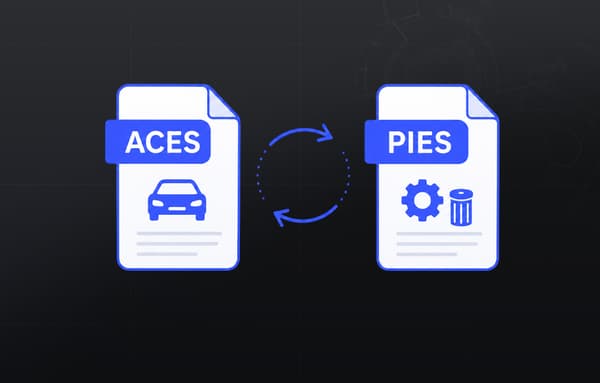
Cross-reference data travels with the same industry standards as the rest of the catalog. PIES, the product attribute standard covered in the ACES and PIES guide, includes an interchange segment where brands publish OEM and competitive cross-references for their parts. Brands vary widely in how completely they populate it, which is why a distributor aggregating multiple suppliers ends up owning the reconciliation: deduplicating conflicting mappings, filling gaps from supplier spreadsheets, and deciding which source wins when two brands disagree about an equivalence.
That ownership question is the practical takeaway. Someone in the business has to own cross-reference data the way someone owns pricing: with a source of truth, an update cadence tied to supplier catalog releases, and a process for the exceptions. The sellers who treat interchange as part of catalog operations keep their resolution rate high. The ones who imported a file in 2023 are quietly losing searches today.
Cross-References in the Buying Experience
Data only matters where the buyer touches it, and it should surface in three places.
Search. Any number the buyer types, OEM, competitor, superseded, should resolve to the right product page, ideally showing what was matched so the buyer can confirm. A search that silently redirects with no explanation feels wrong even when it is right.
The product page. Listing known cross-references on the page lets a buyer holding an old part confirm the match themselves, and it is exactly the kind of structured, extractable content AI search surfaces reward.
Alongside fitment. Cross-references answer "is this the same part." Fitment answers "does this fit my vehicle." A serious parts catalog needs both, resolved against the same data layer: Uncap Garage handles the vehicle side with Year-Make-Model filtering on ACES/PIES data, so a resolved number can also be confirmed against the buyer's truck. And for the buyer who has no number at all, only a broken part and a machine, Uncap Diagrams removes the identification problem entirely: they find the part visually on an exploded diagram and order from the pin, no number required.
Those three surfaces cover the three states a parts buyer is ever in: I have a number, I have the wrong number, I have no number.
How to Add Part Lookup and Fitment Search to a Shopify Store
The question usually arrives as an app question, and the honest answer starts earlier: you cannot install data. Every route below assumes the cross-reference and fitment records exist and are owned, because a lookup widget pointed at an empty interchange table resolves nothing, politely.
Route one: a fitment app from the App Store. Fastest to live, right for catalogs whose fitment needs are standard, and the trade-offs between the leading options, data formats, YMM depth, and how each handles ACES imports, are compared in the year-make-model fitment apps roundup. The app supplies the widget and the filtering; the data remains your job.
Route two: metafields plus your search platform. Cross-reference numbers load into product metafields or a supporting table, and the store's search layer indexes them so any equivalent number resolves. This route fits stores that already run a serious search product and want number resolution inside it rather than beside it, and it is how the search-silently-knows experience is built.
Route three: a purpose-built fitment and lookup layer. For catalogs where fitment is the storefront, deep YMM plus engine filtering, per-vehicle garages, diagram ordering, the purpose-built route carries the load: Garage and Diagrams run on ACES/PIES data as a native part of the store rather than a bolted-on widget. This is the route for sellers whose buyers ask fitment questions before price questions.
What It Looks Like Live
Kooks Headers runs this architecture in production: a 60-year performance parts manufacturer on a unified Shopify B2B and D2C storefront, with ACES database integration and a PDM Automotive PIM powering fitment search by year, make, model, and engine, real-time inventory synced from its Infor Visual ERP, and wholesale portals beside the retail experience. The stated results on the case study: a 22% conversion uplift from faster performance and improved product discovery, and a 38% lower total cost of ownership from consolidating the stack. That is what the data-first order of operations buys: the fitment search converts because the ACES data behind it is owned and current.
Where This Fits
Cross-reference data is one layer of the aftermarket catalog stack. The complete guide to aftermarket auto parts ecommerce covers the full picture, fitment data, YMM search, B2B accounts, and the plumbing between them, and the auto parts and aftermarket industry page shows how the layers come together in a real build.
Uncap has been a Shopify Platinum Partner since 2013, with 380+ storefronts launched on Shopify, and parts data architecture, fitment, interchange, and the sync that keeps both current, is one of the deepest patterns in that portfolio. Book a Demo to see what number resolution and diagram ordering look like on your catalog.
Frequently asked questions
How do I add fitment or part lookup to my Shopify store?
In two layers: the data, then the interface. Build or license the cross-reference and fitment records first (PIES interchange segments, ACES vehicle data, your own reconciliation), then choose the surface: a fitment app for standard needs, metafields indexed by your search platform for number resolution, or a purpose-built layer like Uncap Garage when fitment is the core of the store. An app without owned data resolves nothing.
What is a parts cross-reference?
A cross-reference, also called an interchange, is a mapping between equivalent part numbers: an OEM number to its aftermarket replacements, one brand's number to another's, or a superseded number to its current version. Catalogs use these mappings to resolve whatever number a buyer searches to the right product.
What is the difference between a cross-reference and an interchange?
In practice they are the same concept and the terms are used interchangeably. "Interchange" is the older industry term, common in the used and remanufactured parts world; "cross-reference" is more common in new-parts catalogs and in the PIES data standard's interchange segment.
What is a part number supersession?
A supersession is when a manufacturer discontinues a part number and replaces it with a new one. Supersessions chain over time, so a catalog has to follow each number to its current end point, or buyers searching an older number they have used for years will find nothing.
Why do wrong cross-references cause returns?
Because the catalog asserted an equivalence the physical parts do not honor. A near-match mapped as an exact match produces an order that fails at installation, and the buyer reasonably holds the seller responsible. Bad interchange data and bad fitment data produce the same outcome through different doors: a part that does not fit.
Can buyers search by OEM number on a Shopify parts store?
Yes, when cross-reference data is loaded and connected to search, any known equivalent number resolves to the right product. That mapping layer is implementation work on top of the platform, built from the interchange data your brands publish and your own reconciliation of it.