

Most guides to starting an online auto parts store read like guides to starting any store: pick a niche, find suppliers, set up a platform, run ads. All reasonable, and all missing the thing that decides whether a parts store works: fitment. A parts store that cannot answer "does this fit my vehicle" is a returns machine with a checkout, no matter how good the niche or the ad spend. This is the launch sequence with fitment where it belongs, at the center.
Quick answer: Launch an auto parts store in this order: audit your fitment data first, because its quality caps everything downstream. Model the catalog around vehicle applications, build the Year-Make-Model experience on that data, and make search resolve any number a buyer types. Then handle the parts-specific checkout realities, freight, core charges, fitment-aware returns. And decide before launch whether shop and dealer accounts are part of the business, because retrofitting B2B costs more than designing for it.
Step 1: Audit Your Fitment Data Before Anything Else
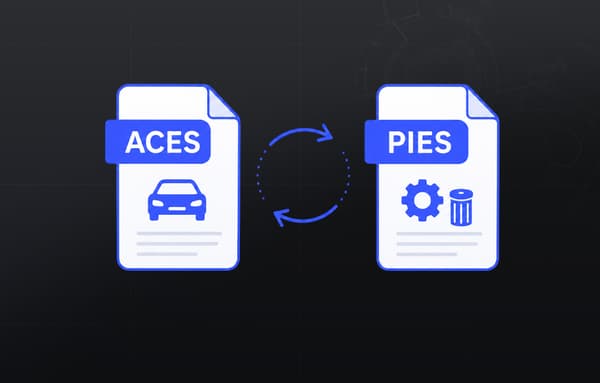
Every downstream decision inherits the quality of this layer, so start here, before platform selection, before design. For each brand you plan to carry, establish what actually exists: clean ACES applications and PIES product files, a spreadsheet of some structure, or nothing but a printed catalog. ACES and PIES, explained in full, are the industry standards for vehicle applications and product attributes, and brands vary enormously in how well they publish them.
The audit output is your real project scope. A catalog of brands with clean ACES/PIES files is weeks of aggregation work. A catalog dependent on suppliers who send PDFs is a data-entry project you should price into the launch plan honestly, or a reason to reconsider which brands make the initial cut.
Step 2: Model the Catalog Around Applications
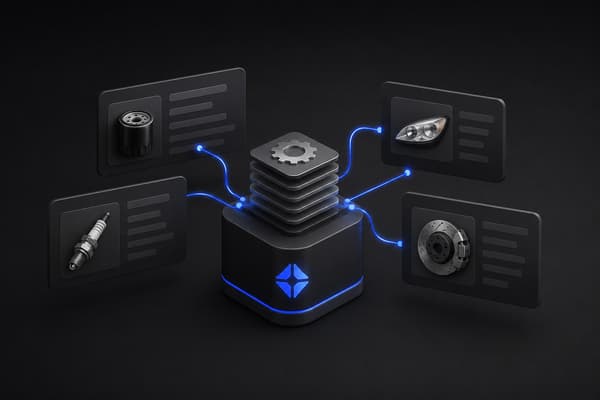
A parts catalog is two datasets wearing one storefront: products, and the vehicle applications that make them relevant. Model them separately and deliberately. The product record carries the PIES side: attributes, images, specifications. The application records carry the ACES side: which years, makes, models, submodels, and engines each part fits.
Two more relationship layers earn their place at this stage. Cross-references and supersessions let a buyer's OEM or competitor number resolve to your SKU, which matters because the highest-intent buyers arrive holding a number. And for assembly-heavy categories, mapping parts to exploded views enables diagram-based ordering, the path for the buyer who knows where the part lives but not what it is called.
Step 3: Build the Year-Make-Model Experience
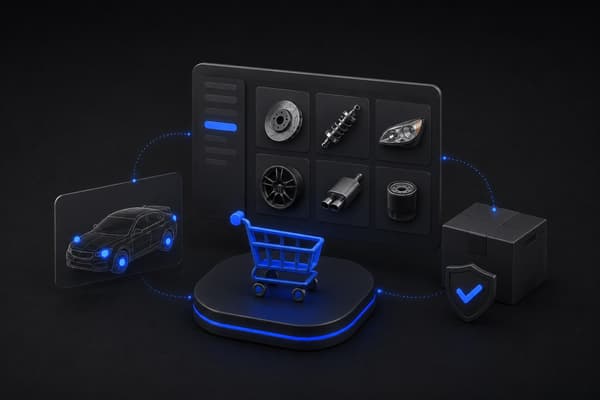
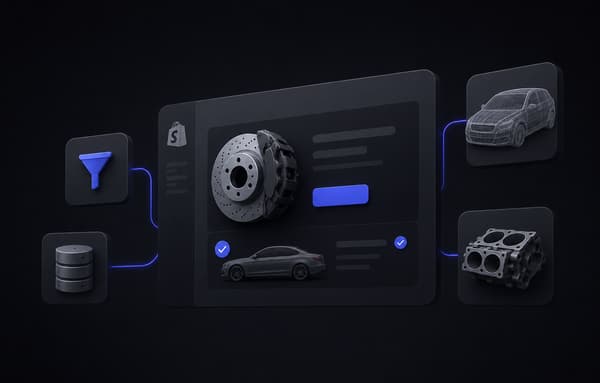
With the data modeled, the buyer-facing fitment layer is what most people picture when they picture a parts store: pick the vehicle, see only what fits. The essentials are a YMM selector that persists across the session, a saved garage for returning buyers, fitment confirmation restated on the product page, and vehicle context carried into the cart, so the order itself records what the parts were bought for.
The tooling decision matters here, and the comparison of YMM fitment apps for Shopify covers the field. The short version: general-purpose fitment widgets filter catalogs fine for retail, and Uncap Garage is the option built for sellers whose buyers include shops and dealers, because it carries account pricing and ERP-synced stock through the vehicle filter instead of stopping at the retail view.
Step 4: Search That Respects the Vehicle
Search in a parts store has one job that generic site search does not: resolve whatever the buyer typed against the vehicle they selected. A part number, OEM, yours, a competitor's, a superseded one, should land on the right product page. A category term should return results already filtered to the selected vehicle. And a zero-results page should be treated as a defect log, because in this category, zero results usually means a cross-reference gap, not a product you do not carry.
Step 5: Checkout for Parts, Not Parcels
Three parts-specific realities break a default checkout. Freight: bumpers, body panels, and exhaust systems ship oversized or LTL, and a checkout quoting flat parcel rates on them either eats the difference or bills it as a dispute later. Core charges: remanufactured parts like alternators and brake calipers typically carry a refundable core deposit, and the checkout has to represent that charge and its refund path clearly, not as a surprise line item. Returns: the policy should be built around fitment confirmation, because your returns rate is a direct function of how much guessing the store allowed upstream, the fitment data return problem is where that math lives.
Step 6: Decide the B2B Question Before Launch
If repair shops, jobbers, or dealer networks are part of the revenue plan, even eventually, design for them now. Company accounts, price lists, and net terms belong in the initial architecture, and the fitment layer has to respect them, a shop's buyer should see fitment-filtered results at their negotiated price against real stock. What a wholesale auto parts portal requires covers that buyer's workflow. Launching retail-only and bolting B2B on later means rebuilding the pricing and account layer under a live store.
The Launch Checklist
Before the store takes real traffic, verify the claims it makes. Spot-check fitment answers against the source data for your highest-volume applications, and type your top 50 OEM and competitor numbers into search to confirm each resolves. Place a test order for an oversized item and confirm the freight quote is one you would honor. Confirm a discontinued part cannot be ordered and its supersession resolves to the current number. And if B2B accounts are live, log in as one and confirm the price shown survives through checkout and invoice.
None of this is glamorous, and all of it is the difference between a store that earns trust in the first week and one that spends months recovering from it.
Where This Fits
This is the launch-sequence view of the territory the complete guide to aftermarket auto parts ecommerce covers as a whole, and the auto parts and aftermarket industry page shows the full build pattern with accounts, ERP sync, and fitment together.
Uncap has been a Shopify Platinum Partner since 2013, with 380+ storefronts launched on Shopify, and fitment-dependent parts stores are one of the deepest patterns in that portfolio. Book a Demo to walk through your brands, your data, and what the launch sequence looks like for your catalog.
Frequently asked questions
What is the first step in launching an online auto parts store?
Auditing your fitment data. The quality and format of the ACES/PIES data your brands supply determines the scope of everything downstream, catalog modeling, search behavior, returns rate, so it has to be known before platform and design decisions, not discovered after.
Can you launch an auto parts store without ACES/PIES data?
Only for universal-fit products like tools, fluids, and accessories. Anything vehicle-specific sold without structured application data forces buyers to guess, and the store pays for that guessing in wrong-part returns and lost trust.
What platform should an auto parts store use?
Shopify covers the platform layer, checkout, catalog, payments, and native B2B accounts, with fitment added through an app or integration, since no platform ships vehicle-application logic natively. The fitment tooling choice matters more than the platform choice for this category.
What makes checkout different for auto parts?
Freight on oversized items (bumpers and exhaust ship LTL, not parcel), core charges on remanufactured parts (a refundable deposit the checkout must represent clearly), and returns policies built around fitment confirmation rather than generic change-of-mind rules.