

Every growing ecommerce business eventually asks the same question: stay on what you have, build something custom, or move to a platform that already does most of the hard work. For businesses selling to other businesses, that decision carries more weight than it does for a typical retail store, since wholesale pricing, company accounts, and net terms aren't optional extras. Here's what actually makes Shopify the right answer for most of them, and where it matters most for B2B and wholesale sellers specifically.
Quick answer: Shopify's core benefits are platform scale and uptime, a checkout built to convert, an app ecosystem of more than 8,000 integrations, and continuous product investment that most competing platforms can't match release for release. For B2B and wholesale sellers, the bigger benefit is that company accounts, custom price lists, and net terms now come built into Shopify itself, work that used to require a separate platform entirely.
What Is Shopify?
Shopify is a commerce platform that runs the storefront, checkout, payments, and back-office operations for millions of businesses, from single-product startups to global brands like Mattel, Gymshark, and Heinz. It's built to handle direct-to-consumer, B2B, retail, and international selling from one system, so a business doesn't need a separate platform for each sales channel it operates.
The Core Benefits of Shopify
Scale and uptime most platforms can't match
Shopify powers roughly 12% of all US ecommerce and served 875 million shoppers in 2024 alone. Merchants have generated more than $1.4 trillion in cumulative sales on the platform. The clearest proof of how the infrastructure holds up under pressure: Shopify merchants did a record $14.6 billion in sales over Black Friday-Cyber Monday 2025, up 27% from the year before, with sales peaking at $5.1 million per minute. That's not a platform that buckles during the exact moment merchants need it most.
Continuous, fast product investment
Shopify ships two major feature releases a year, each bundling well over 100 updates across checkout, admin, apps, and AI tooling. Merchants get that investment without paying for a dedicated engineering team or scheduling downtime for upgrades. That pace also means a store built on Shopify today keeps gaining capability over time instead of slowly falling behind, which is the opposite of what happens on most custom-built or legacy platforms.
A checkout built to convert
Shopify's checkout is engineered specifically to reduce friction at the one moment that matters most: the point of payment. Shop Pay lets returning customers complete an order in a single tap, and the checkout supports Apple Pay, Google Pay, PayPal, and buy-now-pay-later options like Affirm out of the box. Lower friction at checkout translates directly into fewer abandoned carts and a better return on every dollar spent driving traffic to the store.
An app ecosystem that covers almost anything
The Shopify App Store has more than 8,000 apps covering email marketing, loyalty, product reviews, inventory management, and nearly anything else a store might need. Instead of a custom development project every time a business wants new functionality, most needs are a native integration away, and the ecosystem keeps expanding as Shopify's partner network grows.
Selling everywhere from one back end
Shopify connects a single product catalog and inventory count to a store's website, in-person POS, and channels like Instagram, TikTok, Amazon, and Walmart. A sale on any channel updates inventory everywhere else automatically, which matters as soon as a business sells through more than one place at once and can no longer afford to track stock manually across each of them. For a business also running a wholesale side, that same catalog and inventory feed can power a B2B storefront alongside the consumer-facing one, so a single team isn't reconciling stock counts across two disconnected systems.
Security and compliance handled for you
Shopify manages SSL, PCI compliance, and platform-level security updates centrally, so a merchant isn't responsible for patching servers or maintaining compliance certifications on their own. That's infrastructure work most internal teams, and even many outside agencies, aren't equipped to handle at the standard a payment platform requires.
A lower total cost of ownership
Because Shopify absorbs hosting, security, and core infrastructure into the platform itself, the total cost of running a store on it is typically far lower than maintaining custom-built infrastructure or an aging legacy platform, where hosting, security patches, and developer hours all show up as separate, ongoing line items.
Shopify versus building something custom
A fully custom-built platform can, in theory, do anything a business wants. In practice, that flexibility comes with a permanent cost: every feature Shopify ships for free has to be planned, built, tested, and maintained by an internal or agency team instead, indefinitely. For most businesses, the actual differentiation they need lives in a handful of specific workflows, custom pricing logic, a particular quoting process, an unusual fulfillment rule, not in reinventing checkout, hosting, or payment processing from scratch. Shopify lets a team spend its development budget on the few things that are genuinely unique to the business, instead of rebuilding the parts every other ecommerce company also needs.
Where Shopify Might Not Be the Right Fit
Shopify isn't the right platform for every business, and it's worth saying so plainly. Businesses running extremely bespoke, multi-entity ERP orchestration across dozens of legal entities and currencies sometimes need a level of backend control that goes beyond what any hosted platform, Shopify included, is built to offer natively. The same is true for businesses that want to fully own their infrastructure for regulatory or internal-policy reasons rather than running on a hosted platform at all.
For the large majority of B2B, wholesale, and DTC businesses, though, these are edge cases, not the norm. Most of the workarounds people assume require leaving Shopify, complex pricing, approval workflows, ERP sync, are solvable with the right combination of native B2B tools, apps, and custom development on top of the platform, without needing to walk away from everything Shopify already handles well.
Why This Matters Even More for B2B and Wholesale Sellers
Most "benefits of Shopify" content is written for a single-storefront retail seller, but the calculus changes for a business selling to other businesses. B2B and wholesale sellers need company accounts, negotiated pricing by customer, net payment terms, and a checkout experience that matches how a buyer's team actually purchases, none of which a standard retail platform is built around.
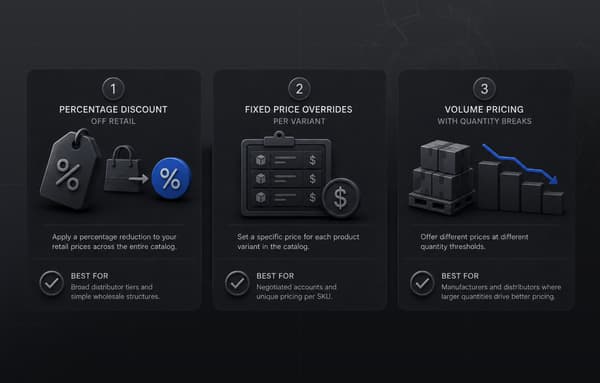
Shopify now ships this natively rather than as a bolt-on. A business can stand up a private B2B storefront where buyers log into an account tied to their business, see pricing already adjusted for their negotiated terms, and check out on net payment instead of a card. Shopify Vault and Shopify Catalogs are what make that possible under the hood, handling which products a given account can see and what they pay for each one. Distributors managing account-specific pricing across hundreds of SKUs, manufacturers running dealer networks, and wholesale sellers juggling volume-based pricing tiers all end up fighting the same limitations on a platform that wasn't built with any of this in mind.
We've built more than 300 projects and migrated over 100 ecommerce brands onto Shopify, the majority of them B2B and wholesale operations, and the pattern holds consistently: the businesses that benefit most from Shopify are the ones whose old platform was never built for a company account, a negotiated price list, or a net-30 invoice in the first place. For the full breakdown of what's included, see our complete guide to Shopify's B2B feature set.
What This Looks Like With the Right Build Partner
The platform gets a business most of the way there. What determines whether a Shopify B2B build actually performs is how the private ordering portal, pricing logic, and checkout are configured for the specific way that business's customers buy. That's the part of the work that turns Shopify's B2B primitives into an order experience a wholesale buyer or repair shop account manager actually wants to use, rather than a generic storefront with a login screen bolted on. A build that gets that configuration right the first time, instead of retrofitting it after launch, is what separates a Shopify B2B project that pays for itself quickly from one that needs a second round of work a year later. That's the kind of planning our Shopify Build engagement is built around.
Frequently asked questions
What are the benefits of Shopify?
The core benefits are platform scale and reliability, a checkout built to convert, a large app ecosystem, and continuous feature investment without the cost of maintaining that infrastructure yourself. For B2B and wholesale sellers specifically, the bigger benefit is that company accounts, custom pricing, and net terms are now native to the platform instead of requiring a separate system.
Is Shopify good for B2B and wholesale businesses?
Yes. Buyers can log into accounts tied to their business, see pricing already adjusted for their terms, and pay on invoice instead of by card, all handled natively by Shopify instead of requiring a dedicated B2B platform or a heavily customized build. It's a genuine fit for manufacturers, distributors, and wholesale sellers, not just direct-to-consumer retail.
How much does Shopify cost?
Shopify's standard plans start around $29 a month for the Basic plan when billed annually, with higher tiers for growing and advanced businesses. Shopify Plus, built for higher-volume and more complex B2B and enterprise sellers, is priced separately based on the business's needs.
Who is Shopify best for?
Shopify fits businesses ranging from a single-product startup to global enterprise brands, but it's a particularly strong fit for any business selling across more than one channel, whether that's direct-to-consumer plus wholesale, online plus in-person, or domestic plus international, since all of it runs from one system instead of several disconnected ones.
Is it better to build a custom platform instead of using Shopify?
For most businesses, no. A custom platform can be tailored to anything in theory, but it also means building and maintaining checkout, hosting, security, and every future feature indefinitely. Shopify handles that foundational layer, freeing up development budget for the specific workflows, pricing logic, or integrations that actually differentiate the business. Custom builds tend to make sense only for the small set of businesses with backend requirements that genuinely fall outside what any hosted platform supports.