


You are on Shopify Advanced and growing. Orders are stacking up, your team is filling operational gaps by hand, and someone mentioned Shopify Plus. The platform fee comes up. $2,300 a month. You close the tab.
This guide is for before you close the tab. Shopify Plus is Shopify's enterprise commerce tier, starting at $2,300 per month on a 3-year contract. For a lot of operators, that number ends the conversation. But the real question is not what it costs. It's whether what you get back is worth more than what you pay, and whether the timing makes sense for where your operation is right now.
Here is a complete breakdown of what Shopify Plus is, what it actually costs, what is included, and who should and should not upgrade.
What Is Shopify Plus?
Shopify Plus is Shopify's enterprise commerce plan, designed for high-volume merchants and complex commerce operations that have outgrown the capabilities of standard Shopify plans. It includes custom checkout logic via Shopify Functions, a full native B2B wholesale suite, workflow automation through Shopify Flow, unlimited staff accounts, multi-store management across up to 10 stores, and 24/7 priority support with a dedicated Merchant Success Manager.
The difference between Shopify Advanced ($399/month) and Shopify Plus ($2,300+/month) is not speed or hosting reliability. Those are strong on all Shopify plans. The difference is the set of commerce capabilities that simply do not exist below Plus: custom checkout logic, native company account infrastructure for wholesale, and the organizational tooling to run a multi-store, multi-market operation from one admin.
Shopify Plus launched in 2014 and is used by over 50,000 merchants globally. It runs on fully managed cloud infrastructure. Unlike open-source platforms, you do not manage servers, apply security patches, or plan for infrastructure scaling. Shopify handles all of that as part of the monthly fee.
Shopify Plus Pricing in 2026
Platform Fee by Contract Term
Shopify Plus starts at $2,300 per month on a 3-year contract or $2,500 per month on a 1-year contract. On the 3-year term, that is $27,600 per year. On the 1-year term, $30,000 per year. The 3-year commitment saves $2,400 annually.
Most merchants who are confident the platform fits their operation lock into the 3-year term. The 1-year term is the right call if you are still evaluating whether Plus matches your requirements or if you are in a period of significant business change.
Variable Pricing for High-Volume Stores
Shopify's Plus pricing page says: "More complex, higher volume businesses switch to a variable platform fee based on their revenue and business model." Shopify does not publish the threshold or the rate, so if your volume is high or your business structure is complex, ask Shopify for the fee that applies to you before you budget.
Transaction Fees
Transaction fees are separate from the platform fee and apply to every sale you process.
With Shopify Payments, Shopify's pricing page lists Plus online standard card rates of 2.25% + 30¢, online premium card rates of 2.95% + 30¢, an extra 1% for international cards, and in-person card rates of 2.3% + 10¢. Shopify notes that card rates vary by country.
If you use a third-party payment processor, Shopify charges 0.20% per transaction on top of your gateway's own fees. At $5M in annual sales, that adds $10,000 per year in Shopify fees. For the vast majority of Plus merchants, Shopify Payments is the financially smarter choice. You can verify current payment rates directly in Shopify's payment fee documentation.
What Is Included in Shopify Plus?
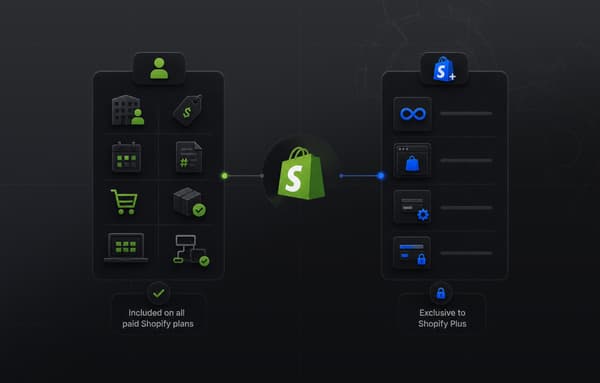
Your monthly Shopify Plus fee includes the following. These are core plan features, not add-ons. The official feature list is maintained on Shopify's Plus plan documentation.
Commerce infrastructure:
Unlimited staff accounts (versus up to 15 on Advanced and up to 5 on Grow).
200 inventory locations (versus 10 on all lower plans).
Up to 10 stores under one Organization Admin, including 9 expansion stores for international markets, wholesale operations, or region-specific storefronts.
Shopify POS Pro included for up to 20 retail locations, or up to 200 locations when Shopify Payments is active.
Automation and checkout customization:
Shopify Flow handles rule-based workflow automation for order management, inventory alerts, fraud detection, customer tagging, and fulfillment routing. No coding required for standard flows.
Shopify Functions (checkout extensibility) lets your development team build custom checkout logic: percentage discounts for specific customer segments, buy-X-get-Y promotions, custom shipping rule logic based on order attributes, payment method filtering, and post-purchase upsell flows built into the checkout itself. This is a Plus-exclusive capability.
One important note: Shopify Scripts reached end-of-life in June 2026. Any store that built checkout customization on Scripts needs to migrate to Shopify Functions before that deadline passes. If your existing Plus store is still running Scripts-based checkout logic, that is an urgent migration item.
B2B wholesale features:
Company accounts with multi-contact hierarchies and role-based permissions across locations and buyer groups.
Customer-specific price lists enforced at login, so each buyer sees their negotiated pricing before adding anything to cart.
Gated product catalogs per company, restricting which products each account can see and purchase.
Net payment terms (Net 15, Net 30, Net 60, Net 90) enforced at checkout for approved accounts.
Purchase order capture at checkout, so B2B buyers can reference a PO number on every order.
Tax exemption certificate management for wholesale buyers purchasing for resale.
Self-service B2B buyer portal for reorder without rep involvement.
International commerce:
Shopify Markets for multi-currency, multi-language, and market-specific catalog and pricing management from a single Shopify admin.
Expansion stores for markets that require separate legal entities, localized storefronts, or completely distinct brand identities.
Analytics and customer acquisition:
Shopify Audiences, which uses Shopify's aggregated purchase data to build lookalike audience segments for paid advertising across Meta, Google, and other channels.
Organization Admin for centralized store management, reporting, and user permissions across all stores under one Plus contract.
Support and onboarding:
24/7 priority support via phone and live chat (standard plans offer chat only).
A dedicated Merchant Success Manager assigned to your account.
Launch support from a Shopify Launch Engineer for new Plus merchants.
Shopify Plus Academy for team training and platform education.
How Shopify Plus Compares to Other Shopify Plans
The jump from Shopify Advanced to Shopify Plus is the most significant in the entire plan lineup. Here is what actually changes.
Staff accounts: Basic includes no additional staff accounts, Grow allows up to 5 and Advanced up to 15. Plus is unlimited. For a wholesale operation with a sales team working quotes and orders out of the Shopify admin, this ceiling matters.
Checkout customization: Shopify Functions, the tool that lets you build custom checkout logic, is a Plus-only feature. It does not exist on Basic, Grow, or Advanced. If you need conditional discounts, custom shipping rule logic, or post-purchase flows built into the checkout itself, Plus is the only option available inside Shopify.
B2B features: Since April 2, 2026, Shopify B2B runs on every paid plan, including company accounts, catalogs and payment terms. On the Basic, Grow and Advanced plans you can assign up to 3 active catalogs across all your B2B markets. Plus adds unlimited catalogs, deposits and partial payments, which matters once a wholesale program prices many accounts differently.
Transaction fee savings: Shopify Advanced charges 0.6% on sales processed through third-party payment gateways. Shopify Plus charges 0.2%. That 0.4% gap produces $2,000/month in savings at $500,000/month in sales. At that volume, the transaction fee savings nearly cover the entire cost premium of Plus over Advanced ($2,300 vs. $399 = $1,901 difference).
Multi-store management: Shopify Advanced supports one store per plan. Plus gives you up to 10 stores, all manageable from a single Organization Admin. For brands running a wholesale store alongside a DTC store, or regional storefronts for international markets, this single-admin infrastructure only exists on Plus.
Shopify Markets (full capability): Lower-tier plans have limited Shopify Markets functionality. Full multi-currency, multi-language, and market-specific pricing management from one backend requires Plus.
The Real Total Cost of Shopify Plus
The $2,300/month platform fee is where the cost starts, not where it ends. Most Plus merchants spend significantly more once the complete picture is counted.
App spend: Plus does not include third-party apps. Marketing, loyalty and reviews, subscriptions, upsell and search tools are each billed by their own vendor, usually monthly and often tiered by volume, so price your actual app list from each app's Shopify App Store listing before you budget, and allow for overage charges during peak periods.
Theme and development: A premium Shopify theme from the Theme Store costs $250 to $400 one-time. A custom theme developed by a Shopify Plus agency typically runs $10,000 to $50,000 depending on complexity. Ongoing development and optimization retainers at mid-market Plus operations commonly land between $5,000 and $20,000 per month.
Migration costs (one-time): Moving to Shopify Plus from another platform is a one-time cost that does not recur, but it affects the first-year total significantly. Data migration typically runs $5,000 to $20,000. SEO and URL redirect mapping adds $3,000 to $10,000. ERP integration setup ranges from a few thousand dollars for a pre-built connector app to $30,000 to $150,000 or more for a real-time B2B integration with ERP pricing, credit limits, and customer hierarchies, depending on the ERP.
Monthly total estimates by store scale:
For a store doing $1M/year in revenue, the realistic monthly total including platform fee, apps, and development support lands around $5,000 to $7,000. At $5M/year, expect $10,000 to $15,000 per month. At $20M/year with variable platform pricing, $20,000 to $30,000 per month is not unusual.
None of these estimates include payment processing fees, which are billed separately and represent a significant line item at scale.
The Real Cost for a B2B Distributor Specifically
A distributor's Plus budget looks different from the DTC estimates above, in both directions. The marketing app stack shrinks: a wholesale operation rarely needs the $2,000/month email-and-SMS layer, the loyalty platform, or the upsell tooling that dominate DTC app spend. What replaces it is heavier and more structural: the ERP integration is the peer cost of the platform itself, typically the largest line after the platform fee, because live inventory, account pricing, and order flow into the ERP are what make a B2B storefront trustworthy at all. Add a PIM if the catalog runs deep, and B2B-specific tooling like quoting where the sales motion needs it.
The other difference is what the spend replaces. A DTC brand weighs Plus against its previous platform bill; a distributor weighs it against the cost of taking orders by phone, fax, and rep transcription, which is why the honest evaluation is a cost-to-serve comparison rather than a software comparison. Consolidation is where the number usually lands: Kooks Headers reports a 38% lower total cost of ownership after consolidating its stack onto a unified Shopify B2B and D2C storefront. And for distributors leaving a legacy platform, the full three-year math, licenses, hosting, patching, and developer hours included, is modeled line by line in the Magento vs Shopify Plus 3-year TCO comparison.
Is Shopify Plus Worth It for B2B Manufacturers and Distributors?
This is where the conversation shifts if you are running a wholesale operation rather than a DTC brand.
Before Shopify Plus's native B2B infrastructure, running wholesale on Shopify meant stacking apps: customer-tagged pricing tools that broke during Shopify updates, password-protected collections that created friction for buyers, manual draft order workflows that your sales rep built and sent by hand for every single order. It worked. It also required constant maintenance, created a fragile buyer experience, and made it almost impossible to give a wholesale buyer the self-service reorder capability they expect from a modern commerce platform.
Today, Shopify Plus handles the core wholesale requirements natively. Company accounts let you manage a regional distributor with six buyers, each with different pricing tiers and location-specific catalogs, all under one account hierarchy. Your negotiated price list is enforced at login. Net 30 terms appear at checkout for approved accounts. Purchase orders get captured there too. The buyer portal handles routine reorders without a rep needing to create a draft order every time.
For a mid-market manufacturer evaluating whether to stay on a legacy ERP commerce portal or move to Shopify Plus, the comparison that matters is not Shopify Plus at $27,600 per year versus Shopify Advanced at $4,788 per year. It is Shopify Plus at $27,600 per year versus the $80,000 to $200,000 annual total cost of running wholesale commerce on a legacy developer-dependent platform, including license fees, custom development, hosting infrastructure, and the maintenance overhead that never gets cheaper.
Uncap has been a Shopify Platinum Partner since 2013, with 380+ storefronts launched on Shopify for manufacturers, distributors, and wholesalers. The pattern we see consistently: the legacy ERP portal costs more to maintain than a modern Shopify Plus operation costs to run. The math usually becomes obvious once you add up what the previous platform actually costs, including the developer hours that are invisible in the monthly budget.
For B2B operators who need Shopify to communicate with their ERP in real time, Uncap Connect handles the integration architecture for NetSuite, SAP, Microsoft Dynamics, QuickBooks, and other mid-market ERPs natively, without middleware layers that break on version updates.
When Does Shopify Plus Pay for Itself?
The clearest break-even calculation starts with transaction fees.
Shopify Advanced charges 0.6% on sales processed through third-party payment gateways. Shopify Plus charges 0.2%. The 0.4% difference saves $2,000/month at $500,000/month in sales. The cost premium for Plus over Advanced is $1,901/month. At $500K/month in sales, the transaction fee savings essentially cover the platform premium, before you count the value of any Plus-specific feature.
Most merchants find the financial case becomes clear at $1M or more in annual revenue, roughly $83,000/month in sales. Below that threshold, the fixed cost is difficult to justify unless a specific Plus feature (usually custom checkout logic or the B2B suite) is driving a concrete revenue or operational outcome.
Beyond transaction fees, upgrade to Shopify Plus when your operation needs one of these:
Custom checkout logic. If your growth requires percentage discounts for specific customer segments, buy-X-get-Y offers, conditional shipping rules, or post-purchase upsells built into the checkout itself, Shopify Functions on Plus is the only way to implement this without a third-party app.
Native B2B at scale. Running wholesale and DTC from one Shopify admin, with company accounts, customer-specific pricing, net terms at checkout, and a self-service buyer portal, requires the Plus B2B suite. Basic plan B2B handles simple use cases. Complex wholesale programs outgrow it quickly.
High-traffic reliability. Shopify Plus handles 10,000+ checkouts per minute without performance degradation. If your current platform has ever slowed or failed during a major sale event, Plus eliminates that risk.
International expansion. Shopify Markets at full capability and expansion stores give you the infrastructure to run multiple regional storefronts from one admin without duplicating your operations team.
Staff at scale. When your team regularly hits the 15-account ceiling on Advanced, Plus removes the constraint.
Stay on Shopify Advanced if your annual revenue is under $1M, your technical and B2B requirements fit within what Advanced provides, or the fixed cost is material to your margins at your current scale.
How to Get Started with Shopify Plus
Shopify offers a free trial for Shopify Plus on their website, which lets you explore the platform and native feature set before committing to a contract term.
The quality of the architecture and scoping work done before development begins is the single biggest factor in whether a Plus migration delivers on its ROI or turns into a costly rebuild six months later. Merchants who go into Plus implementations without a clear brief on what they need the platform to do, from checkout logic to ERP integration to B2B account structure, spend more and get less.
If you are evaluating Shopify Plus for a B2B wholesale or manufacturing operation, Talk to Our Experts and we will walk you through whether the platform and investment make sense for your specific situation. The conversation is free. The information will be specific to your operation, not a generic sales pitch.
If you have already decided on Plus and need the right migration path, Uncap's Shopify Migration practice is the structured implementation path we use to get B2B brands live on Shopify Plus without the scope drift that sinks most replatforming projects.
Frequently asked questions
What is Shopify Plus?
Shopify Plus is Shopify's enterprise commerce plan, built for high-volume merchants that need custom checkout logic, unlimited B2B catalogs and deposits, workflow automation, multi-store management, and 24/7 priority support. It starts at $2,300 per month on a 3-year contract and is available to any merchant regardless of size, though the ROI case typically becomes clear at $1M or more in annual revenue.
How much does Shopify Plus cost per month?
Shopify Plus costs $2,300 per month on a 3-year contract or $2,500 per month on a 1-year contract. Shopify says more complex, higher volume businesses switch to a variable platform fee based on their revenue and business model. Transaction fees and app costs are billed separately on top of the platform fee.
How much is Shopify Plus per year?
On a 3-year commitment, Shopify Plus costs $27,600 per year ($2,300/month). On a 1-year commitment, $30,000 per year ($2,500/month). The 3-year term saves $2,400 annually.
What is the difference between Shopify and Shopify Plus?
Shopify Plus adds capabilities that do not exist on standard plans: custom checkout logic via Shopify Functions, unlimited B2B catalogs plus deposits and partial payments, unlimited staff accounts, up to 10 stores under one admin, full Shopify Markets for international commerce, and 24/7 phone support with a dedicated Merchant Success Manager. Shopify B2B itself runs on every paid plan, with up to 3 active catalogs below Plus.
Is Shopify Plus worth it?
Shopify Plus is worth the investment when you are generating $1M or more annually and need custom checkout logic, unlimited B2B catalogs or deposits, workflow automation, or reliable performance under high traffic. The break-even point where transaction fee savings from Plus offset the premium over Advanced is approximately $500,000 per month in sales. Below that threshold, the financial case depends on whether a specific Plus feature is solving a problem with a clear revenue or cost impact.
What is the downside of Shopify Plus?
The main downsides are cost and contract length. The platform fee alone runs $2,300 to $2,500 per month, and total monthly costs including apps and development commonly reach $5,000 to $20,000 for a mid-size operation. The 3-year contract locks you in for three years. Shopify Plus also does not replace ERP, financial management, or warehouse management systems, which most mid-market B2B operators need alongside it.
What is the difference between Shopify B2B and Shopify Plus B2B?
Since April 2, 2026, Shopify B2B runs on every paid plan, including company accounts, catalogs and payment terms. On the Basic, Grow and Advanced plans you can assign up to 3 active catalogs across all your B2B markets. Shopify Plus adds unlimited catalogs, deposits and partial payments. For a wholesale program with many differently priced accounts, or one that needs deposits on net-terms orders, Plus is the right level.
What is Shopify Functions?
Shopify Functions is the checkout customization tool available exclusively on Shopify Plus. It lets developers build custom logic for discounts, shipping rules, payment method filtering, and post-purchase upsells directly into the checkout. Shopify Functions replaced Shopify Scripts, which reached end-of-life in June 2026. Any store still running Scripts-based checkout logic needs to migrate to Functions.
How much does Shopify Plus really cost for a B2B distributor?
Start from the same platform fee ($2,300 to $2,500 per month), then budget structurally rather than by DTC averages: the ERP integration is typically the largest line after the platform itself, a PIM joins the stack when the catalog runs deep, and the marketing app layer shrinks compared to a DTC brand. The honest comparison is not against the old platform bill but against the cost of phone, fax, and rep-transcribed ordering, and against the legacy stack being retired: consolidation is where distributors usually find the savings.
Does Shopify Plus have a free trial?
Yes. Shopify offers a free trial for Shopify Plus on their website so you can explore the platform before committing to a contract.