

Every farm-equipment dealership already runs on exploded diagrams. The parts counter spends its day inside the OEM's electronic parts catalog, walking assembly views, reading callouts, pulling part numbers. Meanwhile the customer is on the phone describing the same part from memory: third bolt down on the left side of the header drive, the one with the funny shoulder on it.
One side of the call is looking at the answer. The other side is guessing at it. The whole case for dealer diagram ordering is closing that gap: put the diagram the counter already trusts into the customer's hands, with a cart attached.
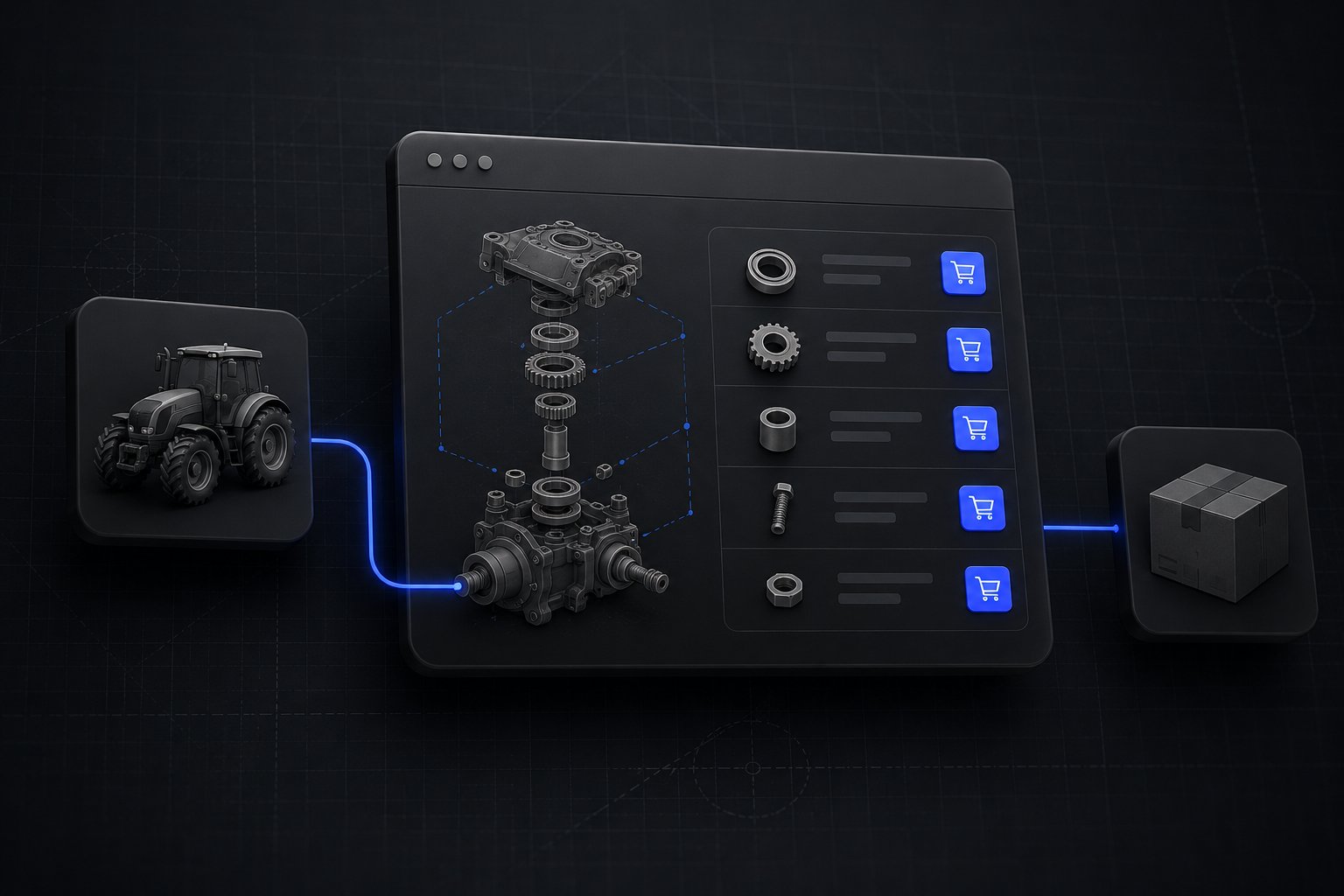
Quick answer: Diagram ordering lets a dealer's customers find parts the way the counter does, navigate to the machine's exploded view, click the callout, order the part, at their account pricing, against real stock. For dealers, the payoff is specific: wrong-part returns drop because the customer verified the part visually, counter time shifts from lookup labor to judgment calls, and orders arrive after hours, which is when farmers actually plan repairs. The diagrams already exist. The work is making them shoppable against the dealer's own inventory.
The Dealer's Paradox
Farm-equipment dealers have the strongest diagram culture in all of parts retail and expose almost none of it to customers. Internally, the parts lookup is sacred: nobody at the counter guesses at a combine part from a text description when the assembly view is a click away. Externally, the same dealership's web presence is often a brand brochure with a phone number, which means every parts transaction funnels through the counter's working hours and the customer's ability to describe machinery over the phone.
The result is an odd inversion: the buyer with the machine in front of them, who can see exactly where the part lives, has less information access than the person forty miles away in the store. Diagram ordering un-inverts it. The customer navigates the same visual logic the counter uses, and the phone call, when it still happens, becomes two people looking at the same drawing, which is a shorter and better call.
What It Does to Returns
A wrong part at a farm-equipment dealership is not a small event. The parts are heavy, the freight is real, and the customer who drove in from forty miles out, or waited two days for delivery, has lost repair time in a business where repair time is measured against weather. The dealer eats the restock and some goodwill; the customer eats a day. Nobody wins an argument about whose description was at fault.
Most of those wrong parts trace to the same root: identification by description. The customer said, the counter heard, the part shipped, the machine disagreed. Diagram ordering removes the description step entirely. The customer confirmed the part in its position on the assembly, the same verification a counter person performs by turning the screen around and asking "this one?", done before the order instead of after the return. The general mechanics of what makes an exploded view genuinely shoppable, live callouts, multi-part selection, stock states on the drawing, are covered in selling parts by diagram; the dealer-specific point is that repairs on implements rarely need one part, and a diagram that carts the seal, the gasket, and the fasteners together is the difference between one order and three.
What It Does to the Counter
In season, the parts counter is the dealership's bottleneck. The queue is long, the phone is ringing, and a meaningful share of the traffic is lookup labor, finding the number for a customer who knows the machine and the location of the part but not its name. Every one of those lookups a customer performs themselves, on the diagram, at nine in the evening, is counter capacity handed back to the transactions that need a human: the judgment calls, the supersession puzzles, the customer who needs to be talked out of the wrong repair.
The after-hours point deserves its own sentence, because farm schedules are not retail schedules. Repair planning happens at the kitchen table after dark, and an ordering channel that closes at 5:30 asks the customer to hold a thought overnight that a diagram and a cart could have captured on the spot, with will-call pickup scheduled for morning.
What It Takes to Build
The raw material exists: OEM parts books and exploded views organized by machine, model, and serial range. Three layers turn them into a dealer's selling surface.
The machine layer. Diagrams are model- and often serial-range-specific, so the customer's path starts with equipment selection, the make/model/serial identity work that ag fitment generally demands, with a saved fleet so the returning customer's 8320 is one tap away rather than a re-interview.
The mapping layer. Every callout has to resolve to the dealer's actual SKU, current, superseded numbers followed to their end, priced at the account's rate. Uncap Diagrams is built for exactly this: exploded views as a native Shopify experience, pins mapped to live products, multi-part selection carried to the cart intact.
The truth layer. The stock state a customer sees on the diagram has to match the shelf, which for a dealership means syncing from the business system rather than maintaining counts twice, Uncap Connect's territory, so a callout showing available at the Colby store is a promise the Colby store can keep.
None of it requires the dealer to become an ecommerce company. It requires the dealer's existing knowledge, the diagrams, the inventory, the account pricing, to reach the customer without a phone call in the middle.
Where This Fits
Diagram ordering is one piece of what farm customers increasingly expect from their dealer's digital channel, the fuller picture is in what modern farmers expect from agribusiness ordering, and the complete vertical build, accounts, pricing, ERP sync, storefront, is on the agriculture and farming industry page.
Uncap has been a Shopify Platinum Partner since 2013, with 380+ storefronts launched on Shopify, and diagram-based ordering for OEM and aftermarket parts is one of the patterns that portfolio was built on. Book a Demo to see an exploded view become an order against a dealer catalog.
Frequently asked questions
What is diagram ordering for a farm-equipment dealer?
The dealer's customers navigate exploded parts views, the same assembly drawings the parts counter uses internally, and order by clicking callouts, with each pin resolving to the dealer's real SKU, the account's pricing, and live stock. Identification happens visually, the way the trade already thinks.
How does diagram ordering reduce wrong-part returns?
It removes identification-by-description, the root of most wrong-part orders. A customer who confirmed the part in its position on the assembly has done the same verification a counter person does on screen, before purchase instead of after a return trip that costs the farmer repair time and the dealer freight and goodwill.
Do dealers have to create the exploded diagrams themselves?
No, the diagrams exist in OEM parts documentation organized by model and serial range. The build work is mapping: linking each callout to the dealer's current SKU, following supersessions, and keeping stock and pricing live behind the pins.
Why does after-hours ordering matter for equipment dealers?
Because repair planning on a farm happens in the evening, after fieldwork, and a counter that closes at 5:30 forces the customer to carry the order overnight. A diagram channel captures the order when the decision happens, with will-call pickup scheduled for the morning.