

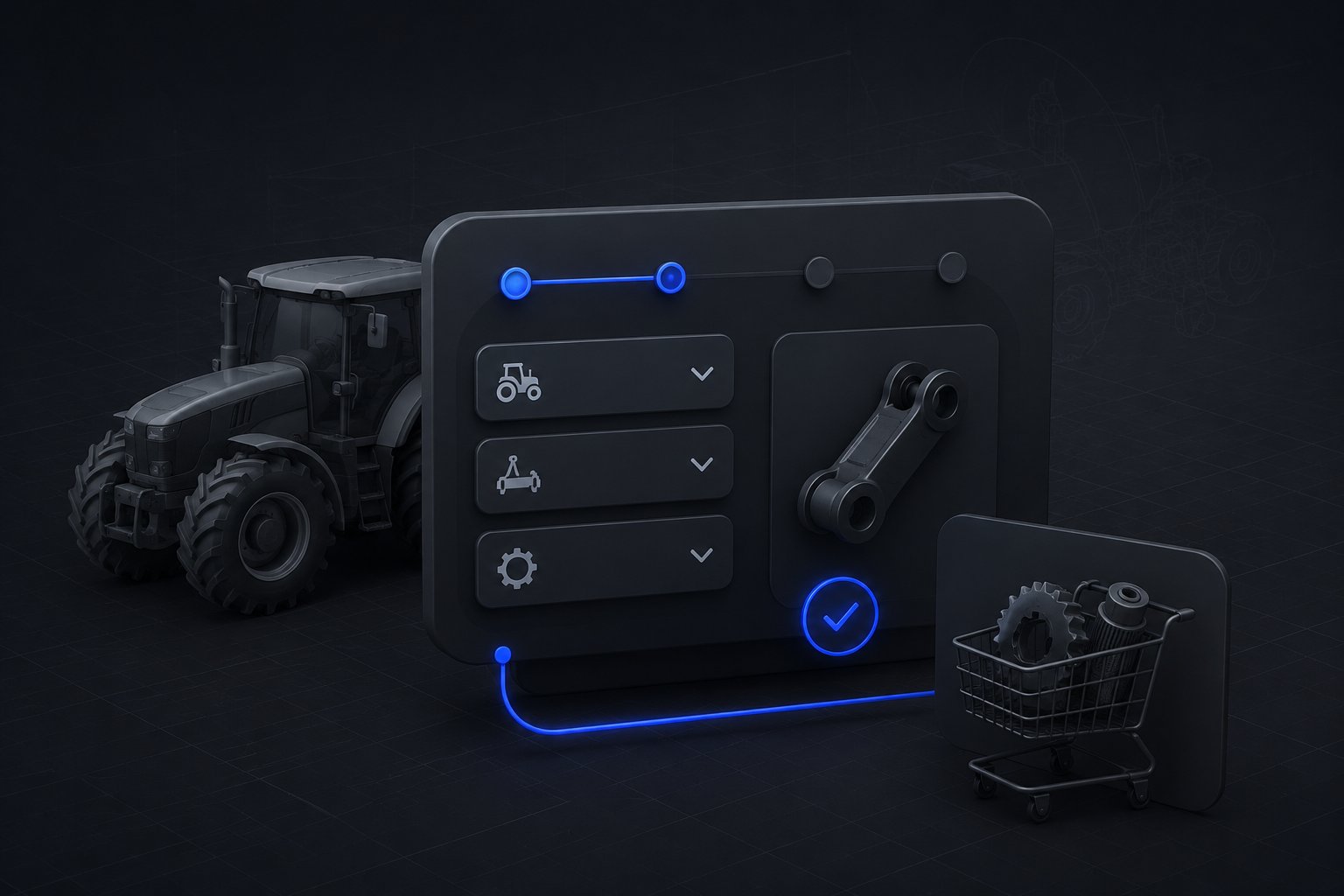
A combine down in October is not a customer service ticket, it is a harvest losing daylight. That urgency shapes everything about how farm equipment parts get bought: the buyer needs the right part, identified with certainty, on the first try. Which is why so much tractor and implement parts volume still runs through dealer counters and phone calls, and why the sellers who get identification right online are pulling that volume onto their storefronts.
Quick answer: Selling tractor and implement parts online works when the store can answer "does this fit my equipment" with the same certainty as a parts counter. That takes make and model fitment filtering built from OEM parts book data, serial-number awareness for mid-production changes, and diagram-based ordering for the buyer who knows where the part lives on the machine but not what it is called. Ag has no ACES/PIES equivalent, so the fitment data layer is something the seller assembles and owns.
Why Ag Fitment Is Different From Automotive
Automotive parts sellers inherit an industry data infrastructure: ACES for vehicle applications, PIES for product attributes, published by brands and aggregated by data providers. Agriculture has no equivalent standard. Fitment truth for a tractor, planter, or tillage tool lives in OEM parts books, organized by make, model, and, critically, serial-number ranges, because manufacturers change components mid-production. Two tractors of the same model year can take different parts depending on where each fell in the production run.
That difference has a practical consequence: an ag parts seller cannot buy their fitment layer off the shelf. It gets assembled, from OEM references, supplier cross-data, and the institutional knowledge currently living in the heads of counter staff. The sellers who treat that assembly as a data project, with a source of truth and an owner, build a catalog that answers fitment questions reliably. The ones who treat it as product-page copy end up with a store that says "fits most models," which a farmer reads correctly as "call to confirm."
Make and Model Fitment That Actually Works
The buyer-facing layer looks familiar from automotive: pick the equipment, see only what fits. The ag version has its own requirements underneath.
The equipment picker has to speak the buyer's fleet: make, model, and where it matters, serial range, across tractors, combines, planters, sprayers, and the implements behind them. A saved-equipment feature earns its keep faster in ag than almost anywhere, because the fleet barely changes year to year, and a returning buyer who selects "my 8320" from their saved list is one step from a filtered catalog of exactly what fits it.
Uncap Garage brings that fitment architecture to equipment catalogs: the buyer's machine filters the catalog, and for B2B accounts, dealers, co-ops, high-volume operations, the filtered results carry account pricing and real stock rather than a generic retail view. The filter is only trustworthy if the storefront and the inventory system agree, which is an ERP sync question as much as a fitment one.
Diagrams Are the Native Language of Ag Parts
Ask anyone who has bought a bearing for a planter unit: the natural way to find an implement part is not a search bar, it is the exploded parts diagram. The buyer knows where the part lives on the machine, follows the diagram to the callout number, and orders from there. Every OEM dealer portal works this way because it matches how mechanical knowledge is actually organized in the buyer's head.
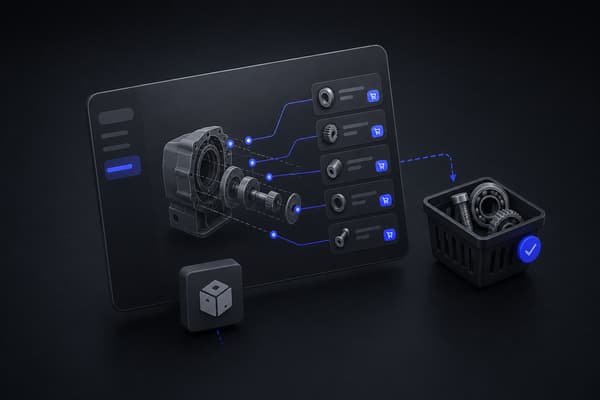
An independent seller or aftermarket brand can offer the same experience: Uncap Diagrams turns exploded views into a shoppable surface, the buyer clicks the pin on the diagram, and the part lands in the cart, with multi-part selections carrying through as a proper bill of materials rather than a list to retype. For implements especially, where a repair often means an assembly's worth of wear parts rather than one SKU, diagram ordering is the difference between a complete order and three follow-up shipments.
Fitment search and diagram ordering are not competing approaches. They serve the two states an ag parts buyer is in: I know the part, confirm it fits, and I know the machine, help me find the part.
Two Buyers, One Catalog
Farm equipment parts sellers usually serve both the operator buying for their own fleet and the trade buyer, dealers, repair shops, co-ops, purchasing on account. The catalog and fitment layer should be shared; the commercial layer should not.
The operator side works like informed retail: fitment confidence, clear availability, fast checkout. The trade side needs what B2B always needs, account pricing, terms, and reorder speed, running on the same fitment-filtered catalog. What that account experience looks like for ag specifically, and why farmer-facing expectations are rising alongside it, is covered in what modern farmers now expect from agribusiness ordering and the broader look at agribusiness software for agricultural ecommerce at scale.
Seasonality sharpens all of it. Parts demand in ag is not smooth: planting and harvest compress a year's urgency into weeks, and a store that identifies parts correctly at 9 PM in April is worth more than one that is merely cheaper. Speed of correct identification is the product.
Where This Fits
Fitment and diagram ordering are the ag-specific layer of a parts commerce build; the agriculture and farming industry page covers the full picture, accounts, pricing, ERP sync, and the storefront experience together.
Uncap has been a Shopify Platinum Partner since 2013, with 380+ storefronts launched on Shopify, including for manufacturers, distributors, and wholesalers, and equipment fitment, from automotive to agriculture, is one of the deepest patterns in that portfolio. Book a Demo to see make/model filtering and diagram ordering against an equipment catalog.
Frequently asked questions
Is there an ACES/PIES equivalent for tractor and implement parts?
No. ACES and PIES are automotive standards. Agricultural fitment data lives in OEM parts books organized by make, model, and serial-number range, which means an ag parts seller assembles and owns their fitment data layer rather than licensing a finished one.
Why do serial numbers matter for tractor parts fitment?
Because manufacturers change components mid-production. Parts books specify applications like "serial number 123456 and up," so two machines of the same model can take different parts. A fitment layer that stops at make and model will be confidently wrong for exactly those cases.
What is diagram-based parts ordering?
The buyer navigates an exploded parts diagram of the machine or assembly, clicks the callout for the part they need, and orders from the pin, no part number or search terms required. It mirrors how OEM dealer portals work and how mechanical knowledge is actually organized.
Can one store serve both farmers and dealer accounts?
Yes, and it should. The fitment-filtered catalog is shared, while B2B company accounts layer dealer pricing, net terms, and reorder workflows on top. Running two separate stores means maintaining the hardest asset, the fitment data, twice.