

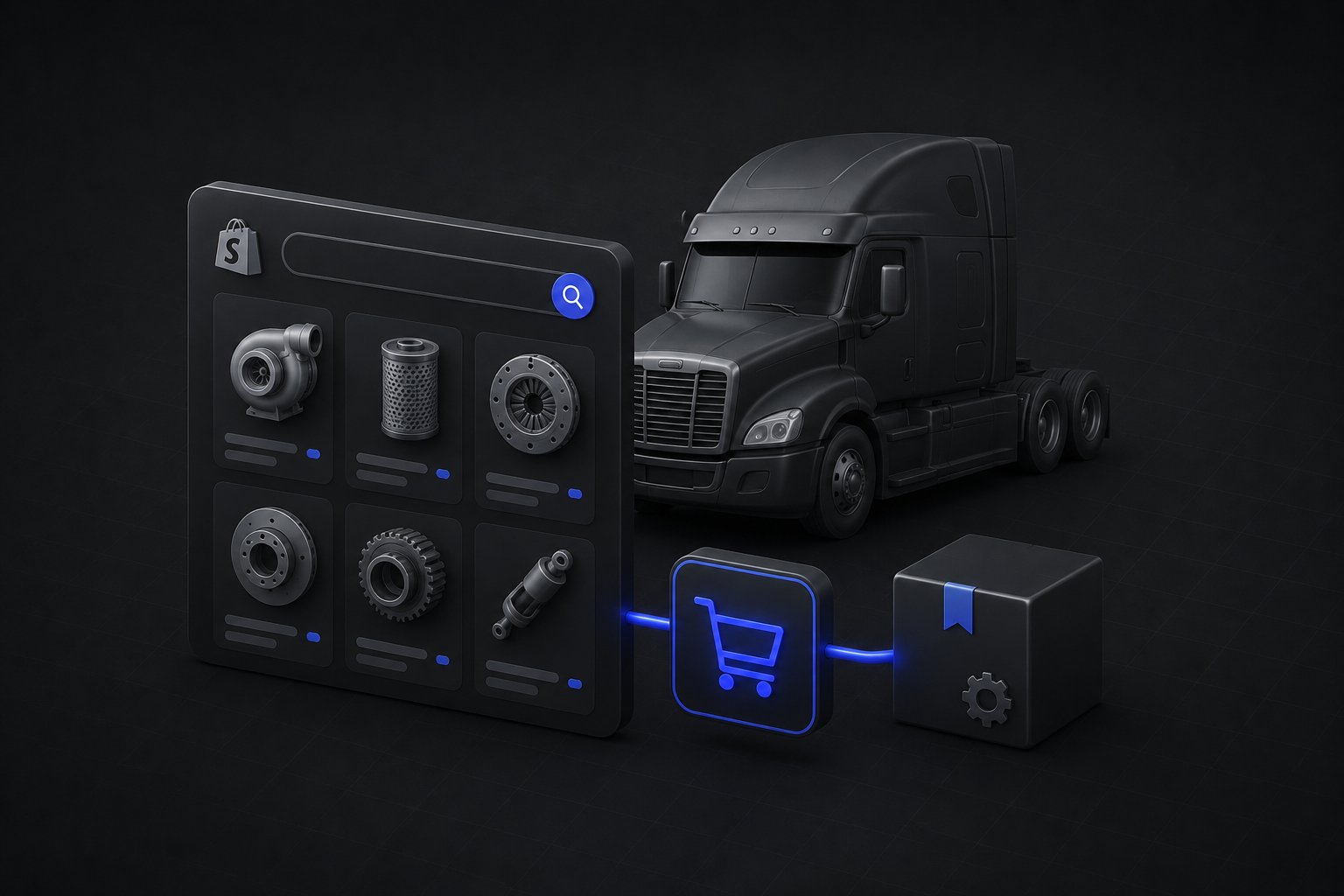
A Class 8 truck that is not moving is a business losing money by the hour, and everything about heavy-duty parts commerce follows from that clock. The buyer, a fleet manager, a service shop, an owner-operator at a truck stop, is not shopping; they are racing a downtime meter, and they will pay a fair price to the seller who can prove the part is right and get it there first. Search this category and you find sellers competing on exactly those terms, same-day cutoffs and free-shipping thresholds, and not one page telling the distributor how to build the channel those sellers run on. This is that page.
Quick answer: Heavy-duty parts ecommerce is won on three mechanics that light-duty stores never need. Finding works by application and interchange, not year-make-model: buyers identify parts by engine, transmission, or axle model and serial range, or by a competitor's part number they already have, which makes cross-reference the primary search mode. Money works on cores: remanufactured components carry core charges that the storefront has to show, track, and credit when the old unit comes back. And accounts work like fleets: multi-location companies with negotiated programs, purchase orders, and a hard requirement for real availability by warehouse, because a part that is in stock three days away is not in stock for a truck on a lift today.
The Finding Problem: Application and Interchange, Not YMM
Light-duty parts search runs on year, make, and model. Heavy-duty runs on what is actually in the truck, because two identical tractors from the same year can carry different engines, transmissions, and axles, and a decade of component swaps later, the VIN is a starting hint rather than an answer. The authoritative identifiers are the component's own: engine model and serial range, transmission model, axle model, and the buyer usually has them, photographed off the data plate from under the hood.
The second finding mode matters even more: the number the buyer already has. Fleets standardize maintenance around part numbers, and the mechanic's question is rarely "what fits this truck" but "what crosses to this number", an OEM number to its aftermarket equivalents, one aftermarket brand to another, the discontinued number to its replacement. Cross-reference data is the search index for this category, and the parts cross-reference guide covers how that data becomes a working storefront feature. The pattern is proven on live builds: E3 Spark Plugs runs a blended B2C and B2B Shopify store with a cross-reference application that converts competitor part numbers to its own SKUs, which is exactly the move a heavy-duty distributor makes at catalog scale.
The Money Problem: Cores Are a Second Ledger
Remanufactured components, starters, alternators, turbos, injectors, brake shoes, run on exchange economics: the price plus a core charge, refunded when the rebuildable old unit comes back. For the storefront, that is not a discount mechanic; it is a second ledger. The product page has to show the core charge honestly so the checkout total is not a surprise, the order has to carry the core as its own line, and the account has to track cores outstanding, credited, and rejected, because a fleet running dozens of reman parts a month will reconcile that ledger against yours.
The operational rule is the same one that governs pricing everywhere in B2B: the ERP owns the truth, the storefront displays it. Core charges, eligibility, and credit status belong in the same sync that carries account pricing and inventory, so the buyer's portal view of cores outstanding matches what accounting will actually credit.
The Account Problem: Fleets Buy Like Fleets
A fleet account is a company with locations, buyers, and a negotiated program: contract pricing on the lines they run, purchase orders on every transaction, terms instead of cards, and often a parts list standardized across the fleet. The storefront's job is to mirror that program per account, and then to answer the only question that beats price in this category: where is the part, physically, right now. Availability by warehouse, with honest cutoff times for same-day shipment, is the conversion feature, and it depends on the inventory architecture the multi-warehouse visibility and order routing guide lays out: one truth per location, routing that commits stock from the right building, and promises the WMS can keep.
The wholesale layer beneath fleets is repair shops, and that channel has its own design: shop accounts ordering daily against a discount matrix, which the wholesale auto parts portal guide covers for the light-duty side and which transfers to heavy-duty service shops nearly whole.
The Speed Problem Is Really a Truth Problem
Every seller in this category advertises speed. The differentiator underneath is truth: the store that says in stock and means it, quotes a cutoff and makes it, and shows the fleet its own pricing without a phone call. That is less a feature list than a discipline, live inventory by location, ERP-mirrored account pricing, cores reconciled, and it is the same architecture every serious B2B parts operation runs. For the auto parts and aftermarket businesses Uncap builds for, heavy-duty is the sub-vertical where that discipline pays fastest, because the buyer's downtime meter prices every failure of it.
Uncap has been a Shopify Platinum Partner since 2013, with more than 380 B2B commerce projects delivered for manufacturers, distributors, and wholesalers. Talk to Our Experts if your fleet accounts still phone in orders your storefront should be catching, the application-data and cross-reference mapping is the first working session.
Frequently asked questions
How is heavy-duty truck parts ecommerce different from auto parts ecommerce?
The finding model changes: buyers identify parts by engine, transmission, and axle model and serial range, or by cross-referencing a part number they already have, rather than by year-make-model alone. The money model adds core charges on remanufactured parts, and the accounts are fleets with negotiated programs, POs, and terms rather than individual shoppers.
What is a core charge and how should a storefront handle it?
A refundable deposit on remanufactured parts, charged at sale and credited when the rebuildable old unit is returned. The storefront should show it on the product page, carry it as its own order line, and give accounts a running view of cores outstanding and credited, synced with the ERP that ultimately issues the credit.
Why does cross-reference matter so much in heavy-duty parts?
Because fleets and mechanics start from a part number, an OEM number needing an aftermarket equivalent, a competitor's brand crossing to yours, or a discontinued number needing its replacement. A storefront that answers number-to-number queries becomes the first stop, and one that cannot sends the buyer back to the phone.
What do fleet accounts need from an online parts store?
Their program mirrored: contract pricing per account, PO and terms at checkout, standardized parts lists, and availability by warehouse with honest same-day cutoffs. Speed promises only convert when the underlying inventory and pricing truth holds, which is an ERP sync discipline before it is a storefront feature.