
In October 2023, we asked eight people building B2B commerce on Shopify, agency founders, partners, and Shopify's own ecosystem, where they thought the platform's B2B push was headed. Their answers are below, unedited. Three years on, the biggest thing they were debating has an actual answer now.
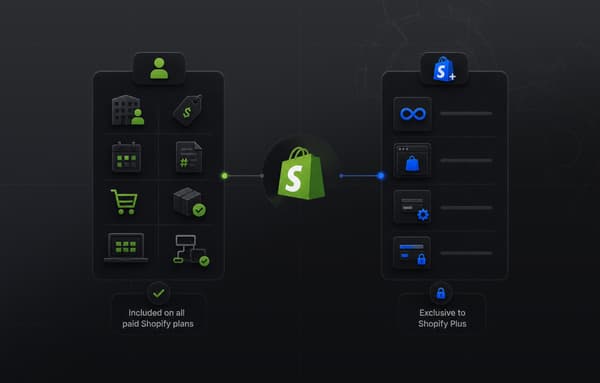
Quick answer: As of April 2026, Shopify B2B is no longer exclusive to Shopify Plus. Core features, company profiles, catalogs, volume pricing, and net terms, are now available on the Basic, Grow, and Advanced plans at no extra cost. Plus still gets unlimited catalogs, direct company-level catalog assignment, deposits and partial payments, and contextual checkout, but the foundation that used to require an enterprise plan is now available to nearly every Shopify merchant.
What Changed: B2B Moved Beyond Shopify Plus
For the first several years of Shopify's B2B push, the honest answer to "do I need Shopify Plus for B2B" was yes. Company accounts, custom pricing, and net terms lived behind the Plus paywall, and that shaped every conversation about whether Shopify could handle a real wholesale operation.
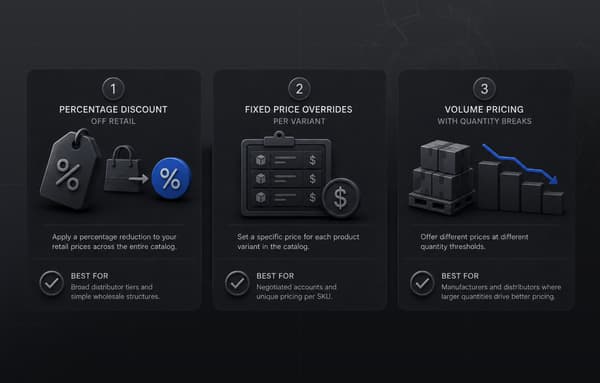
That changed on April 2, 2026, when Shopify announced it was extending its core B2B features to the Basic, Grow, and Advanced plans at no additional cost. Merchants on any plan can now set up company profiles for wholesale buyers, assign up to three custom catalogs with tailored pricing, apply volume discounts and quantity rules, and offer net payment terms and vaulted credit cards, without upgrading to Plus first.
Plus did not lose its edge entirely. Shopify's own plan comparison still reserves a handful of capabilities for Plus merchants: unlimited B2B catalogs instead of three, direct catalog assignment to specific companies and locations for customer-level pricing, deposit requirements and partial payments, and contextual checkout and storefront customization through Shopify Markets on the Advanced and Plus plans. For a merchant running a handful of wholesale accounts, the non-Plus tiers now cover most of what matters. For a distributor managing dozens of accounts with customer-specific catalogs and complex payment structures, Plus is still the plan built for that scale.
The results Shopify has published from merchants already running B2B are real and specific, not projected. One automotive parts manufacturer using Shopify B2B saw a 25% reduction in time spent on back-office tasks and a 40% increase in average customer spend after buyers could self-serve instead of ordering by phone. Across the platform, Shopify reports B2B merchants seeing up to a 4.1x increase in reorder frequency compared to DTC orders, and up to a 33% increase in self-serve orders within six months of adoption.
The Original 8 Perspectives, From October 2023
These quotes were gathered in October 2023, when Shopify's B2B features were still new and largely Plus-exclusive. They are presented here exactly as given, as a record of what the people building on this platform were actually saying at the time.
We are in the early innings of Shopify B2B and that means we are due for some major growth. B2B Commerce has historically been complex and expensive. Shopify will disrupt B2B Commerce just like they disrupted B2C by bringing the costs down creating a greater need for digital innovation in B2B.
Isaiah Bollinger, SVP of Distribution at Zaelab
I think Shopify's made a great deal of progress beefing up its B2B e-commerce capabilities for Plus merchants. Shopify's push to be a commerce platform that extends beyond direct-to-consumer makes sense as merchants need to meet customers where they are. Shopify's recent deal with Faire is another signal that they're serious about giving merchants more B2B growth opportunities.
Peter Kang, Co-founder & CEO at Barrel
Shopify Plus has taken a significant stride into new territory with its focus on B2B e-commerce. This direction became apparent when Shopify acquired Handshake, signaling a commitment to enhancing the platform for B2B distributors, manufacturers, and suppliers. Initially, Shopify's Wholesale Channel did not live up to expectations, in my view, and this misstep temporarily hindered advancements in integrating B2B features into the online store platform. However, over the past year, Shopify has shifted its approach, substantially reinforcing these capabilities within storefronts. This has facilitated the creation of not just B2B but also hybrid websites, which are now both robust and versatile. The uptick in adoption and enthusiasm among merchants themselves is a testament to the platform's burgeoning success. Shopify has now positioned B2B as a cornerstone of its ecosystem, indicating that B2B e-commerce will be a focal point in their product development strategy. Our agency, which specializes in serving B2B clients, is eager to continue our collaboration with Shopify. We are enthusiastic about the prospects and confident that the trajectory we're on with Shopify is one of shared success.
Denis Dyli, Founder & Principal @ Uncap
Shopify's move into B2B is a big step for merchants who are looking to launch for the first time or level-up their existing B2B offering. Out of the box, Shopify Plus merchants can now more easily enable price lists, B2B payment terms, and manage customers through Shopify's new "Company Profiles". There's no question that Shopify's native solution will be the silver-bullet for many merchants on their platform who have relatively simplistic B2B needs. For those looking for more advanced pricing configurations, more flexibility around payments, ways to embed their sales team into their B2B operation, or a more customised user-journey, there are limitations to be aware of that may be barriers to going "all in" using Shopify B2B. I have no doubt that Shopify's product roadmap will address many of these limitations over time and right now; for now merchants will need to evaluate what they are willing to compromise for their B2B strategy and online growth!
Chris Mattingly, Co-Founder & CEO at SparkLayer
Shopify Plus B2B has the feel of Shopify Plus circa 2017. The need is clearly there and Shopify has a huge list of upcoming features that will empower brands and the agencies that support them in the coming years.
Nicholas Thomson, Head of Partnerships at The Maze Group
Shopify has traditionally been a D2C platform. Shopify had attempted to address some of the requests with the original Shopify Wholesale channel, but that had a very limited scope and was not an adequate solution for more mature brands. With the revamp of the B2B approach with Shopify B2B and the features that were brought in from the start, it is a clear signal that Shopify will continue to push to empower B2B merchants and departments as much as they do with D2C. I would expect Shopify to distinguish itself not only as a leader but also as a pacesetter in the next couple of years. And, that will lead to brands having a competitive disadvantage if they are not on Shopify B2B, just like the way it is a competitive disadvantage not to use Shopify for D2C.
Amer Grozdanić, CEO and Co-Founder at Praella
Shopify enables us to get work done faster, and cheaper than say compared to a commerce tools or other platforms. It's also a bit friendlier for headless experiences in comparison to BigCommerce. Almost all platforms are at parity nowadays so I do think that we will continue to see Shopify play a strong role in the B2B space as they continue to invest into it. I also think other platforms will also grow at the same time.
Dennis Gorya, CEO, Founder, Partner at Tidal Commerce
As someone deeply entrenched in the ecommerce sphere, the expansion of Shopify into B2B is a thrilling evolution. It's not just about transacting business; it's about reshaping the B2B landscape with a blend of intuitive technology and customer-centric approaches. Shopify has always been a harbinger of retail innovation, and now, with its B2B platform, it's weaving a new narrative that aligns wholesale commerce with the modern, digital-first ethos. The convergence of flexible customization, seamless admin experiences, and the promise of continuous feature enhancements makes Shopify's B2B platform a beacon of what's next in the ecommerce arena. It's an exhilarating time for both Shopify and the countless businesses that will flourish on this inclusive, forward-thinking platform.
How Well Did These Predictions Hold Up?
Read together, the throughline in these eight quotes is the same bet: Shopify's B2B investment was going to keep expanding, and the merchants who got ahead of it would have an advantage. That bet paid off directionally. Isaiah Bollinger's read on Shopify "bringing the costs down" for B2B is close to a literal description of what happened in April 2026, when the features that once required a Plus subscription became available at no extra cost on lower plans. Amer Grozdanić's prediction that skipping Shopify B2B would become "a competitive disadvantage" reads differently now that the platform it applies to is not just Plus merchants, but nearly the entire Shopify base.
The more cautious notes held up too. Chris Mattingly's point about limitations, and the need to evaluate what a business is willing to compromise on, is still the right framing for anyone comparing Basic, Grow, Advanced, and Plus today. The plan comparison above is exactly that evaluation: which features matter enough to justify Plus, and which ones don't.
What This Means If You're Evaluating Shopify B2B Now
The plan question is no longer "can Shopify do B2B." It is which plan's B2B feature set actually matches the complexity of your operation. What that looks like in practice covers the full picture, from company accounts and pricing to ERP and EDI, regardless of which plan tier you land on. A brand with a handful of wholesale accounts and straightforward pricing can likely run on Basic, Grow, or Advanced today, something that was not true three years ago. A distributor with customer-specific catalogs assigned at the account level, deposit and partial payment requirements, or a large enough operation to need unlimited catalogs still has real reasons to be on Plus. The full breakdown of what's included at each level is worth a look before deciding.
Uncap has been a Shopify Platinum Partner since 2013, with 380+ storefronts launched on Shopify, including for manufacturers, distributors, and wholesalers, across exactly this range of complexity. Uncap Connect handles the ERP integration piece that neither plan tier solves on its own, keeping pricing and inventory accurate regardless of which Shopify plan the storefront runs on.
Talk to Our Experts to figure out which Shopify plan and B2B feature set actually fits your catalog, account structure, and back-office systems.
Frequently asked questions
Do I still need Shopify Plus to run B2B on Shopify?
No, not for the core features. As of April 2026, company profiles, up to three catalogs with tailored pricing, volume discounts, quantity rules, net terms, and vaulted credit cards are available on the Basic, Grow, and Advanced plans. Plus is still required for unlimited catalogs, direct catalog assignment to specific companies, deposits and partial payments, and contextual checkout.
What is the real difference between B2B on Plus and B2B on other plans?
The biggest differences are catalog limits, unlimited on Plus versus three on other plans, and whether catalogs can be assigned directly to a specific company or location for customer-level pricing, which is Plus-only. Plus also adds deposit requirements, partial payments, and payment requests per fulfillment, none of which are available on Basic, Grow, or Advanced.
Is Shopify B2B good enough for a real wholesale operation without Plus?
For many mid-sized wholesale operations, yes. If your catalog needs fit within three assigned catalogs and you don't need deposits, partial payments, or company-level catalog assignment, the non-Plus plans now cover the same foundational B2B feature set that used to require Plus. Operations with more complex account structures or payment requirements still benefit from Plus.
Why did these expert predictions from 2023 focus so much on Shopify Plus specifically?
Because at the time, that was accurate: B2B on Shopify was Plus-exclusive in October 2023. The predictions were made about the platform as it existed then, which is exactly why the April 2026 expansion to all plans is worth calling out directly rather than quietly updating the old quotes.