

Powersports takes everything hard about auto parts fitment and multiplies it by five vehicle types. A single customer might own a dirt bike, a side-by-side, and a snowmobile, three machines with three different identity schemes, none of which map cleanly to the year-make-model conventions automotive fitment was built around. The parts sellers who win this category are the ones whose storefronts can answer "does this fit my machine" across all of them, which is a data problem long before it is a design problem.
Quick answer: Powersports fitment means handling multiple vehicle types (motorcycle, ATV, UTV, snowmobile, personal watercraft) whose identities work differently: displacement is part of a bike's identity, trim packages complicate UTVs, and model names get reused across years for machines that share nothing. There is no automotive-grade data standard doing the work for you, so the seller assembles fitment truth from OEM references and supplier data, then serves it through a garage that holds all of a customer's machines, not just one.
Why Powersports Fitment Is Its Own Problem
Automotive sellers inherit ACES and PIES, industry standards that describe which part fits which vehicle in a common language. Those standards were built around cars and trucks, and powersports lives mostly outside their comfort zone. Fitment truth for a quad or a sled comes from OEM parts references and supplier catalogs, each in its own format, which puts the assembly and upkeep of the data on the seller, the same ownership burden tractor and implement sellers carry in agriculture.
Then the machines themselves complicate identity. A motorcycle's displacement is not a detail, it is the machine: a YZ250 and a YZ250F are different vehicles that share a name, and a fitment picker that stops at make, model, and year will confidently serve wrong parts to both owners. UTVs layer trim packages onto model years, and the package often changes wheels, suspension, and cab components, exactly the parts people buy. Model names persist across generations that share almost nothing, and model years split mid-run when a manufacturer revises a platform in March.
None of this is exotic knowledge inside the industry. Every parts counter person at a dealership handles it daily. The work is encoding what the counter person knows into catalog data, so the storefront applies it on every search instead of only when someone experienced picks up the phone.
The Multi-Machine Garage
Here is the behavioral fact that shapes powersports retail: the customer owns several machines, and their attention rotates with the calendar. The seasonality is visible in raw search demand, interest in ATV parts several times higher in September and October than in spring, and it means the customer who bought sled parts in December is the same account that needs PWC parts in June.
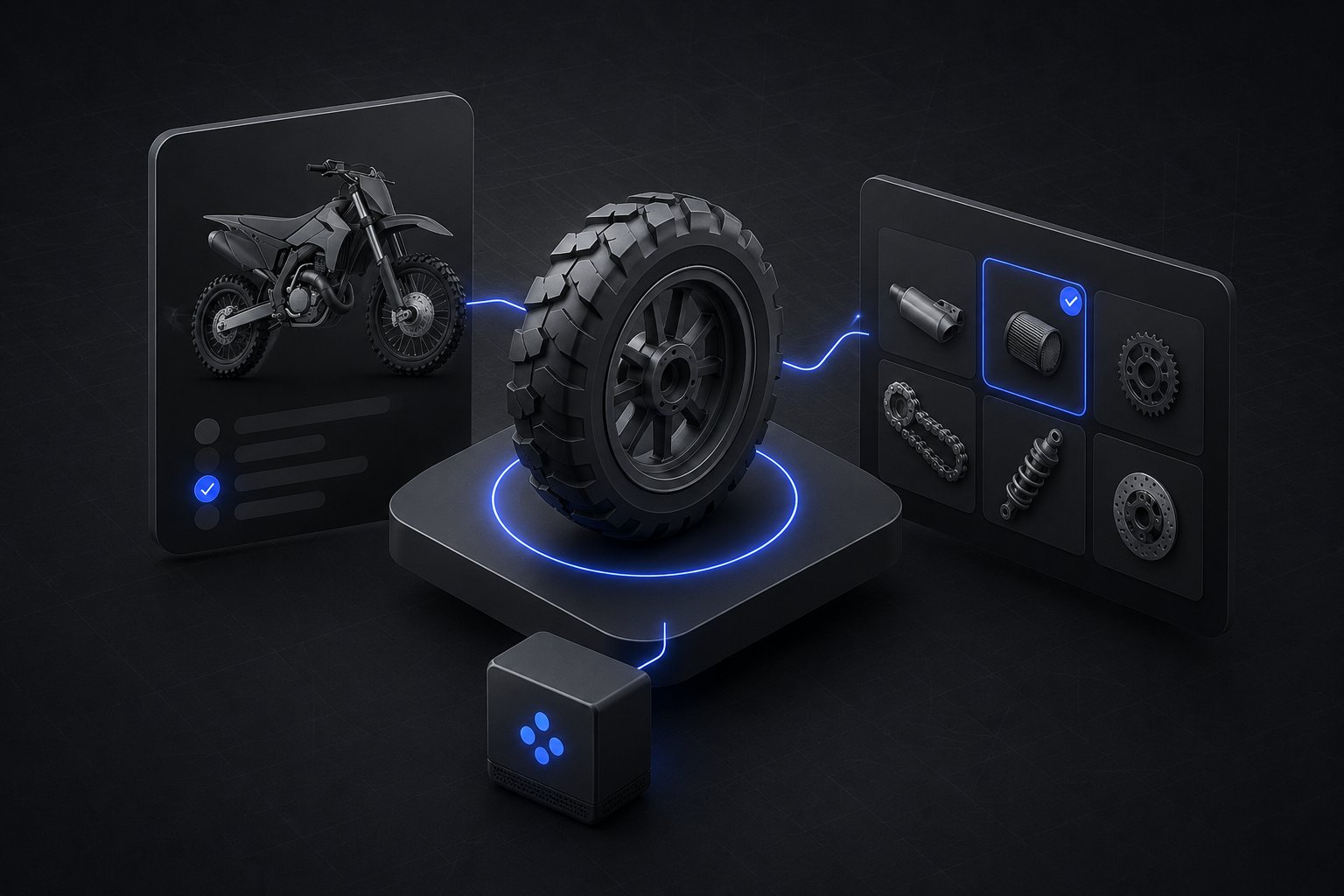
A saved garage built for one vehicle wastes that relationship. The powersports version holds the fleet: the bike, the quad, the sled, each with its full identity (down to displacement and trim), each one tap away. When the customer returns in a different season for a different machine, the store already knows it, and the fitment filter is one selection instead of a re-interview. For a category where the same buyer returns four or five times a year across machines, the garage is less a convenience feature than the account's memory.
Uncap Garage is built for exactly this shape of catalog: vehicle-based filtering where the vehicle schema can differ by type, saved machines per account, and, for sellers with dealer or shop accounts, B2B pricing and live stock carried through the filter rather than a retail-only view.
Model/Year Complexity, Concretely
The traps worth designing against, because each one is a wrong-part order wearing a disguise.
Shared names, different machines. Displacement variants and generational reuse mean the model name alone is never sufficient identity for a motorcycle. The picker has to carry displacement, and the data has to distinguish generations even where marketing did not.
Trim-dependent fitment on UTVs. A base model and its premium package can take different shocks, wheels, and cab parts in the same model year. If the fitment data stops at model, the storefront is guessing on precisely the SKUs where guessing is costly.
Mid-year platform changes. When a revision lands partway through a model year, fitment splits by serial or VIN range, and the honest storefront says so on the product page instead of letting a coin flip decide the return rate.
OEM number searches. Powersports buyers arrive holding OEM part numbers constantly, off the old part, out of a microfiche screenshot, from a forum thread. Those numbers need to resolve to your SKUs, including superseded ones, which is cross-reference data doing its job.
Diagrams Are Half the Category
Powersports buyers grew up on exploded parts diagrams. OEM microfiche culture runs deep here, the standard way to find a carburetor gasket for a 1998 two-stroke has always been the diagram, and the sellers who dominate OEM parts online built their entire experience around it. A powersports storefront that offers diagram-based ordering, the exploded view as a shoppable surface, pins mapped to live SKUs, meets the category's buyers in the interface they already think in. Fitment search answers "does this fit my machine"; the diagram answers "what is this part called," and a powersports catalog needs both doors open.
The Same Stack, A Different Accent
Everything else a powersports seller needs is the aftermarket stack this cluster already covers: application-based catalog modeling, search that respects the selected machine, checkout built for parts, and the B2B layer if dealers and shops are part of the revenue. The complete guide to aftermarket auto parts ecommerce maps that territory, and the auto parts and aftermarket industry page shows the full build pattern. Powersports is not a different discipline. It is the same discipline with a harder data problem and a more loyal, more seasonal customer.
Uncap has been a Shopify Platinum Partner since 2013, with 380+ storefronts launched on Shopify, and fitment-dependent catalogs are one of the deepest patterns in that portfolio. Book a Demo to see multi-machine fitment running against a powersports catalog.
Frequently asked questions
How is powersports fitment different from automotive fitment?
Three ways: multiple vehicle types with different identity schemas (displacement defines motorcycles, trim packages complicate UTVs), no automotive-grade data standard covering the category consistently, and buyers who own several machines across seasons. The seller assembles and owns the fitment data rather than licensing a finished layer.
Why does displacement matter in motorcycle fitment?
Because it is part of the machine's identity, not an attribute. Two bikes sharing a model name at different displacements are different vehicles with different parts. A fitment picker that omits displacement will serve wrong parts with full confidence, which is worse than serving none.
What should a saved garage do for powersports customers?
Hold every machine the customer owns, bike, quad, sled, watercraft, with complete identity for each, so seasonal returns start from one tap rather than a re-interview. Powersports demand rotates by season across vehicle types, and the garage is what lets one account carry that rotation.
Do powersports stores need diagram ordering as well as fitment search?
Yes, they serve different moments. Fitment search confirms a known part fits the selected machine. Diagram ordering finds the part the buyer can point to but cannot name, which is the native buying pattern for OEM parts in this category.