

Shopify's Wholesale and B2B app category lists more than 230 apps, and Shopify's own B2B tools now cover company accounts, tiered pricing, and net terms natively on every plan. So the real question for most B2B sellers isn't whether Shopify can do B2B. It's whether an off-the-shelf app covers what your operation needs, or whether the account structure, pricing complexity, and ERP connections involved need something built specifically for your business.
Quick answer: Native Shopify B2B handles company accounts, basic tiered pricing, and net terms out of the box. Off-the-shelf subscription apps extend the storefront experience for straightforward wholesale needs. Custom-built apps and integrations come in when pricing has to sync from a real ERP contract, quoting needs a full approval workflow, or account structures are more complex than a subscription app was built to handle.
What "Shopify B2B Apps" Actually Covers
The phrase covers three different things, and mixing them up leads to the wrong purchase.
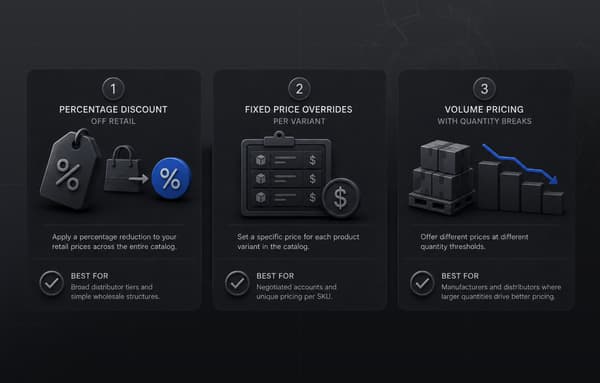
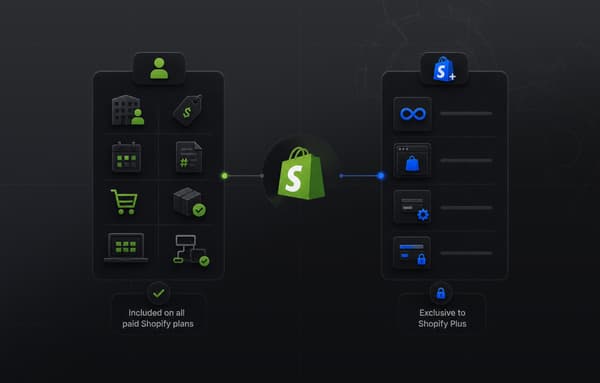
Native Shopify B2B is built into the platform itself: company profiles, up to three assigned catalogs with tailored pricing on every plan, volume discounts and quantity rules, net payment terms, and vaulted credit cards. None of this requires installing an app.
Off-the-shelf B2B apps extend that foundation for common needs the native tools don't fully cover: a more polished wholesale storefront experience, quote request forms, or sales rep tools. Dozens of these subscription apps exist specifically to layer B2B storefront functionality on top of Shopify without a custom build.
Custom-built apps and integrations are what an agency builds when neither of the above covers the actual requirement: pricing that has to pull from a live ERP contract instead of a static price list, a quoting workflow with multi-step approvals, or an account hierarchy more complex than company profiles were designed for.
Where Off-the-Shelf Apps Cover Most of What You Need
For a lot of B2B sellers, the honest answer is that native Shopify B2B plus one well-chosen app is enough. If your pricing structure is a handful of tiers, your net terms are straightforward, and your catalog fits within the assigned-catalog limits on your plan, adding a subscription app to polish the storefront experience is faster and cheaper than building anything custom. There is no reason to pay for a custom build to solve a problem a $50 to $300 a month app already solves well.
Where Off-the-Shelf Apps Run Out of Road
The gap shows up at a specific point: when pricing, account structure, or workflow complexity exceeds what a general-purpose app was built to handle.
A distributor with pricing that comes from negotiated ERP contracts, not a static price list, needs that price to update in the storefront the moment the contract changes in the ERP. A manufacturer with an approval chain, a rep builds a quote, a manager approves it, the customer accepts it, needs that workflow to run inside the buying experience, not as a side process in email. A company selling to dealer networks or health systems with facility-level account hierarchies needs pricing and catalog visibility that maps to that structure exactly, not a generic three-tier price list.
Off-the-shelf apps are built to serve a broad range of merchants reasonably well. They are not built to model one specific company's ERP contract structure or approval chain. Stretching a general-purpose app to do that usually means workarounds that hold up until the business outgrows them, and then break at the worst possible time, during a peak order period or a system migration.
Custom Development vs. a Legacy Custom Portal
The comparison worth making isn't custom app versus off-the-shelf app. It's custom app on Shopify versus a fully custom-built order portal outside Shopify, which is what many enterprise B2B sellers built before Shopify's B2B tools matured.
A standalone custom portal typically means six to twelve months of development, ongoing infrastructure costs, and a dedicated team to maintain it. A custom app built on top of Shopify inherits the platform's checkout, payments, hosting, and native B2B account structure, and only the specific gap, the ERP-synced pricing, the approval workflow, the account mapping, gets built from scratch. That is a materially smaller scope than rebuilding an entire order portal, which is why it typically ships in weeks to a few months rather than the better part of a year. Real cost and timeline numbers for replatforming onto Shopify are broken down separately, since they vary by how much of the old system needs to be rebuilt.
What Uncap Builds When Off-the-Shelf Isn't Enough
This is the category the rest of this guide is really about, and it's easier to describe with what Uncap has actually built than with a generic pitch.
Uncap Quotes is a full configure-price-quote workflow native to Shopify: a rep or a customer builds a quote, it moves through approval, and it converts to an order without leaving the platform. Uncap Connect is the ERP integration layer, syncing pricing, inventory, and order data between Shopify and systems like NetSuite, SAP, or Microsoft Dynamics in real time, so the storefront price always matches the contract on file. Uncap Portal gives key accounts a private ordering experience with their own catalog, pricing, and reorder history. Uncap Garage and Uncap Diagrams solve narrower, vertical-specific problems, Year-Make-Model fitment for automotive parts and diagram-based ordering for OEM parts, that no general-purpose B2B app was built to handle.
Each of these started as the same gap described above: a real operational requirement that native Shopify B2B and the available apps didn't cover.
Deciding Which Path Fits Your Business
Start with native Shopify B2B and see how far it gets you. Add an off-the-shelf app if the storefront experience or a specific workflow needs more than the native tools provide. Only look at custom development once you can name the specific thing neither option handles, a pricing sync, an approval chain, an account structure, rather than a general sense that "Shopify might not be enough."
Uncap has been a Shopify Platinum Partner since 2013, with 380+ storefronts launched on Shopify, including for manufacturers, distributors, and wholesalers. What that looks like end to end covers company accounts, pricing, and integrations together rather than as separate decisions. Talk to Our Experts if you're not sure which side of that line your business is on.
Frequently asked questions
Do I need a custom app, or will an off-the-shelf Shopify B2B app work for my business?
If your pricing fits a handful of tiers, your account structure is simple, and you don't need pricing to sync live from an ERP contract, an off-the-shelf app is usually the right and cheaper choice. Custom development makes sense once you can point to a specific requirement, like contract-synced pricing or a multi-step approval workflow, that a general-purpose app doesn't handle.
Does Shopify B2B already include company accounts and tiered pricing without any app?
Yes. Company profiles, catalogs with tailored pricing, volume discounts, quantity rules, and net terms are native features available on every Shopify plan. Apps and custom development extend that foundation rather than replace it.
How long does a custom Shopify B2B app take to build compared to a standalone portal?
A custom app built on Shopify typically takes weeks to a few months, since it inherits checkout, payments, and account infrastructure from the platform and only builds the specific gap. A standalone custom portal built outside Shopify commonly takes six to twelve months because every piece, from checkout to account management, has to be built from scratch.
Can a custom Shopify B2B app still integrate with our ERP and CRM?
Yes, that is usually the point. Custom development on Shopify is most often built specifically to keep pricing, inventory, and order data synced with systems like NetSuite, SAP, Microsoft Dynamics, or a CRM, in real time rather than through a manual export and import process.