

An irrigation order is a system pretending to be a parts list. The buyer adds drip tape, fittings, a filter, a valve, and everything looks fine in the cart, but the cart has no opinion about whether those parts form a system that will actually water anything. Flow, pressure, and pipe diameter connect every line item to every other one, and a single wrong or missing component, an absent pressure regulator, a mismatched fitting size, an undersized mainline, turns the delivery into a support call. That interdependence is why irrigation retail still leans so hard on counter staff, and why selling it well online is a configuration problem before it is a catalog problem.
Quick answer: Selling irrigation and water systems online takes three layers: pre-engineered kits that package complete, working systems for common scenarios; configuration for the orders where the kit needs to flex, with rules that keep hydraulically invalid combinations unbuildable; and a quote path for system-scale projects and pump decisions, where sizing depends on site facts no storefront rule can know. Kits for the common case, configuration for the variable case, quotes for the judgment case.
Why Irrigation Orders Go Wrong
The questions buyers ask about irrigation are design questions wearing shopping clothes. Should the line be half-inch or three-quarter? PVC or poly? How many emitters can a zone carry? Each answer depends on flow and pressure math the buyer may not have done, and a storefront that lets them buy components independently is quietly letting them commit to a design nobody checked.
The failure modes are predictable. Drip systems ordered without filtration or pressure regulation, both non-negotiable for drip tape to survive. Emitter counts that exceed what the supply line can feed. Fitting diameters that do not match the tubing they arrive with. None of these are exotic mistakes; they are the default outcome of selling interdependent components through independent product pages.
Kits: Selling the Working System
The first fix is packaging the design. A kit for a common scenario, a row-crop drip setup for a given acreage, a greenhouse bench system, a stock-tank watering line, is a pre-engineered answer: every component present, sized to work together, including the unglamorous parts buyers forget. The kit is not a merchandising bundle, it is a bill of materials whose contents someone with hydraulic judgment decided once, so each buyer does not have to.
Good kits also anticipate their own future: the expansion parts, extra tape, couplers, end caps, replacement emitters, offered alongside, because irrigation is a consumable system. Drip tape gets replaced seasonally, fittings break at pull-out, and the reorder relationship is worth as much as the original sale.
Configuration: When the Kit Needs to Flex
Real fields refuse standard scenarios politely. Rows run longer than the kit assumed, the water source is a well instead of a main, the grower wants pressure-compensating emitters for a slope. That variability is where configuration replaces the static kit: the buyer enters the facts the design depends on, area or row length, water source, zone count, and chooses within ranges the rules allow, with each choice constraining the next and the price updating as the system builds.
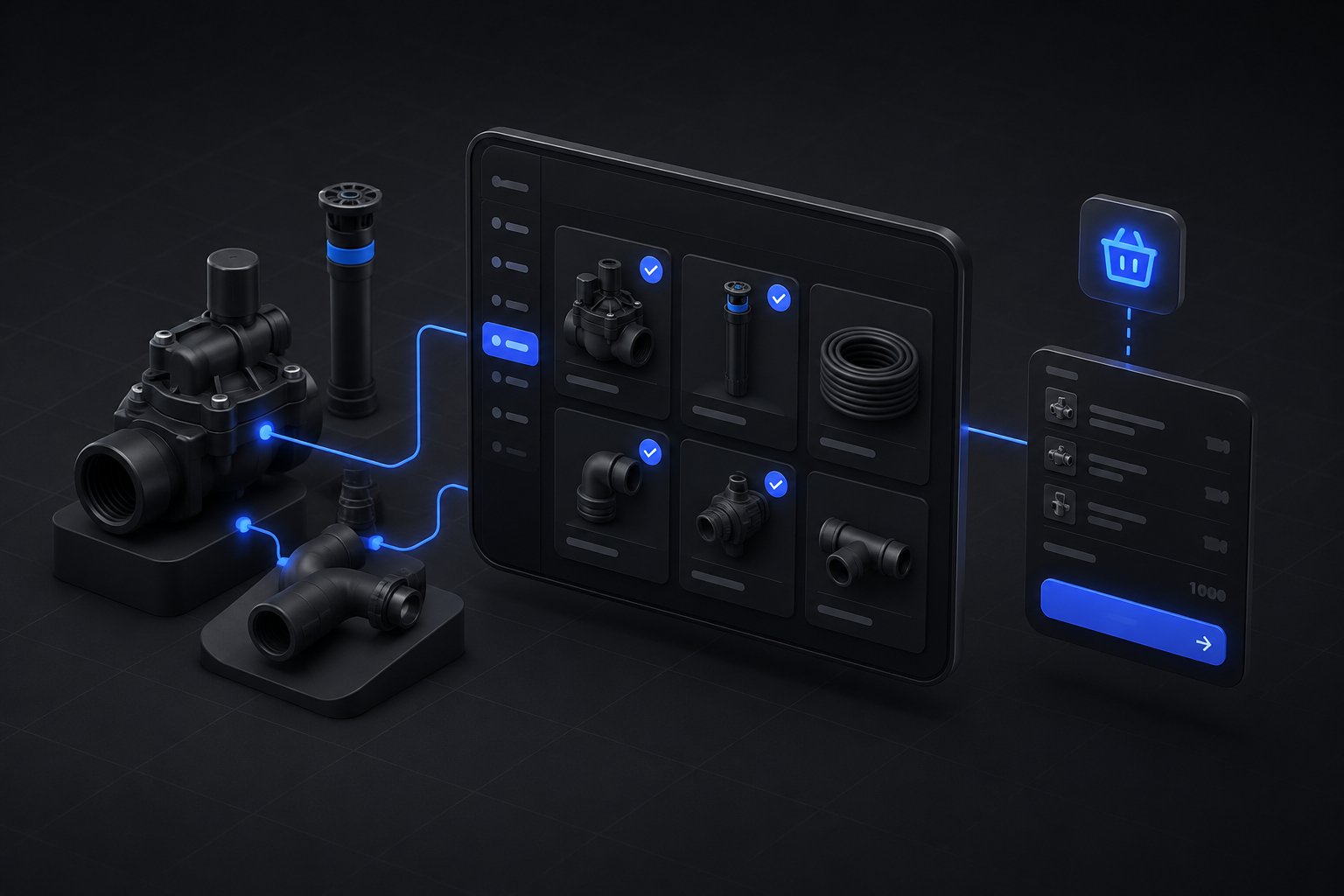
The rules are the product. Tubing diameter options narrow to what the flow supports; emitter spacing choices carry their per-zone limits; the filter and regulator are not optional line items but consequences of the design. Uncap Builder runs that logic at the storefront level, and the configured output is again a real BOM, everything the working system needs, nothing hydraulically wrong, priced at the account's actual rate.
This is the same routing rule that governs selling precision ag technology online: if trained buyers can specify it correctly with rules enforcing validity, it is self-serve. Irrigation just moves the constraint logic from electronic compatibility to hydraulics.
Quoting: Pumps, Projects, and Judgment
Some irrigation decisions should not end at a buy button, and pump sizing is the canonical example. The right pump depends on total head, well depth, distance, elevation, on the real flow requirement across zones, and on the power available at the site. Those are site facts, not catalog facts, and a storefront that pretends to compute them is guessing with the buyer's crop as the stake.
The honest path is a quote: the buyer submits their configured system and site details, a rep, or the distributor's engineer, finishes the pump selection and any system-scale pricing, and the approved quote converts directly to an order with the full configuration intact. Uncap Quotes keeps that workflow native to Shopify, request, revision, approval, conversion, which matters double for the multi-zone farm project: phased delivery, negotiated pricing, and a components list that must not be retyped between the quote PDF and the order.
The quote path is not a failure of self-service. It is self-service for the parts of the purchase that deserve a human, with everything the buyer already specified carried forward instead of re-gathered by phone.
Two Buyers, One Replenishment Engine
Irrigation sellers usually serve the grower directly and the trade, installers, dealers, co-ops, on account. The kit and configuration layers serve both; the commercial layer differs, with trade accounts needing their pricing, terms, and reorder speed. And both converge on replenishment: seasonal drip tape, fittings, emitters, and filter media are the recurring revenue underneath the system sales, which is where the broader expectations of modern farm ordering apply directly, the reorder should be minutes from a phone, not a call to a counter.
Where This Fits
Irrigation is the configured-systems corner of an agricultural commerce build, and the agriculture and farming industry page covers the full stack, accounts, pricing, ERP sync, and storefront experience together.
Uncap has been a Shopify Platinum Partner since 2013, with 380+ storefronts launched on Shopify, including for manufacturers, distributors, and wholesalers, and configurable kits with quote-to-order workflows are one of the deepest patterns in that portfolio. Book a Demo to see hydraulic constraint rules and system quoting against a real catalog.
Frequently asked questions
Can irrigation systems really be sold online given how interdependent the components are?
Yes, when the storefront encodes the interdependence: pre-engineered kits for common scenarios, configuration rules that keep invalid combinations unbuildable, and a quote path for the decisions that need site facts. What fails online is selling interdependent components through independent product pages.
What belongs in an irrigation kit versus a configured order?
Kits fit common, repeatable scenarios where one engineered answer serves many buyers. Configuration fits real-site variability, longer rows, different water sources, slope compensation, where the buyer supplies the facts and rules constrain the choices. Both produce a complete bill of materials rather than a loose parts list.
Why should pump selection go through a quote instead of the cart?
Because correct pump sizing depends on total head, well depth, distance, and available power, site facts a catalog rule cannot know. A quote lets a person finish that judgment, and the approved quote converts to an order carrying the full configured system without re-entry.
Where is the repeat revenue in irrigation ecommerce?
Replenishment: drip tape replaced seasonally, fittings, emitters, and filter media consumed through the year. The system sale opens the account; the reorder experience, saved lists, account pricing, speed, is what keeps it.