

Precision agriculture equipment is the hardest product category in ag retail to sell online, and the easiest to sell wrong. A guidance display that does not match the receiver, an autosteer kit that does not fit the tractor, a rate controller sold without the unlock its buyer assumed was included: each is a plausible-looking cart that becomes a support case. Which is why most precision ag sales still run through a dealer conversation, and why the sellers moving this category online are the ones who rebuilt that conversation as configuration logic instead of removing it.
Quick answer: Precision ag technology covers the hardware and software that lets equipment work by data: GPS guidance and autosteer, section control, variable rate application, displays and receivers, sensors, and the software subscriptions that tie them together. Selling it online requires two paths working against one catalog: configured bundles whose compatibility rules make invalid combinations unbuildable, and a quote workflow for fleet rollouts and deals where pricing, installation, and subscriptions need a human to finish.
What Precision Ag Technology Actually Covers
The category is a stack, and the stack is why selling it is hard.
Guidance and autosteer. GPS receivers and steering systems that keep equipment on line automatically, cutting overlap and operator fatigue. Accuracy tiers, from basic corrections down to centimeter-level RTK, are typically sold as hardware plus a correction subscription.
Section control and variable rate. Controllers that switch planter sections, spray booms, and applicators automatically, and vary seed, fertilizer, or chemical rates by prescription map rather than a flat rate across the field.
Displays, receivers, and the wiring between them. The in-cab display is the hub, and its compatibility with receivers, controllers, and the machine itself is where most configuration errors live.
Sensors, drones, and data. Yield monitors, soil sensors, imagery, and the farm management software where the data becomes decisions, almost always a subscription living alongside the hardware.
Two properties follow from the stack. First, everything has to be compatible with everything else and with the machine it goes on. Second, almost nothing is a one-time purchase: subscriptions, unlocks, and renewals are woven through the hardware.
Why This Category Resists a Standard Storefront
A product page with a quantity box assumes the buyer can specify the product alone. Precision ag breaks that assumption three ways.
Compatibility is multidimensional. The kit has to match the machine, make, model, and often year, and the components have to match each other: display to receiver, receiver to correction service, controller to implement. A buyer facing four dropdowns with no constraint logic between them is being invited to build something that will not work.
The product is part hardware, part software, part service. A working autosteer sale might be a steering kit, a display, an RTK subscription, an activation unlock, and dealer installation. Selling the hardware line alone produces the angriest kind of customer: one holding a box that technically works and practically does not.
Pricing mixes models. One-time hardware, annual subscriptions, per-machine unlocks, and installation labor do not add up in a normal cart without deliberate design, and fleet deals on top of that are negotiated, not listed.
None of this means the category cannot be sold online. It means the storefront has to carry the dealer's checklist inside it.
Configure: Bundles That Cannot Be Built Wrong
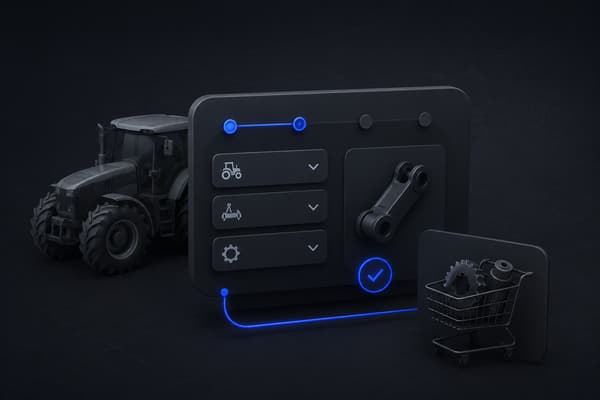
The self-serve path works when configuration rules do the compatibility checking. The buyer starts from their machine, the same make and model entry point that fitment-based parts selling uses, then steps through the kit: guidance level, display, corrections, controller options, with each choice constraining the next and the price updating as the bundle builds. An incompatible combination is simply not offered, which converts the dealer's error-catching into logic that runs on every order.
Uncap Builder handles that layer on Shopify: configuration and bundling at the storefront, with the assembled kit carrying its components as a real bill of materials so fulfillment picks exactly what was configured. Bundles also solve the completeness problem, the harness, the activation, the mounting kit ride along at the right quantities instead of depending on the buyer's memory.
Quote: Where the Deal Needs a Human
Some precision ag purchases should never end in a cart. A grower outfitting six machines, a co-op standardizing a fleet, a deal involving trade-ins, phased installation, or negotiated subscription terms: these are quotes, and pretending otherwise just pushes the buyer to the phone and the order off the platform.
The quote path takes the configured kit as its starting point, the buyer builds what they want, then submits it for pricing rather than payment. A rep completes what rules cannot: fleet discounts, install scheduling, subscription structure. The approved quote converts to an order with the configuration intact. Uncap Quotes runs that loop natively on Shopify, request, revision, approval, conversion, so the fleet deal lives in the same system as the single-kit sale instead of in an email thread beside it.
The routing rule is the same one that works across configurable B2B: if the rules can finish the price, self-serve; if judgment finishes it, quote. Both paths share the catalog, the compatibility logic, and the account.
The Subscription Layer Is a Retention Layer
Corrections subscriptions, software licenses, and unlocks renew, which means a precision ag seller has something most equipment sellers lack: a built-in reason for the customer to come back through the storefront. Renewals surfaced in the account, tied to the machines they belong to, turn the store from a transaction site into the operating record of the customer's technology stack. That account-centric pattern, and what farm operations increasingly expect from it, connects to the broader picture of agribusiness ordering at scale.
Where This Fits
Precision ag is the configured-products layer of an agricultural commerce build; the agriculture and farming industry page covers the full stack, accounts, pricing, ERP integration, and the storefront experience together.
Uncap has been a Shopify Platinum Partner since 2013, with 380+ storefronts launched on Shopify, including for manufacturers, distributors, and wholesalers, and configurable equipment, from storefront bundles to quote-to-order workflows, is one of the deepest patterns in that portfolio. Book a Demo to see compatibility-ruled bundles and fleet quoting against a real catalog.
Related reading: Selling configurable irrigation and water system kits with quoting.
Frequently asked questions
What is precision agriculture technology?
The hardware and software that lets farm equipment operate by data: GPS guidance and autosteer, section control, variable rate application, in-cab displays and receivers, sensors and yield monitors, and the software subscriptions that connect them. The defining trait is that components work as a stack, not as standalone products.
Can precision ag equipment really be sold online?
Yes, when the storefront enforces the compatibility checking a dealer would do: machine-based configuration, constraint rules between components, and bundles that include the harnesses, unlocks, and subscriptions a working installation needs. Without that logic, online sales in this category generate returns and support cases instead of revenue.
Why do precision ag sellers need a quote workflow?
Because fleet rollouts, trade-ins, phased installs, and negotiated subscription terms cannot be priced by catalog rules. A quote path lets the buyer submit their configured kit for a rep to finish, and the approved quote converts to an order without re-entry, keeping negotiated deals on the same platform as self-serve ones.
How do subscriptions fit into selling precision ag hardware?
Corrections services, software licenses, and feature unlocks are recurring purchases attached to specific machines. Selling them alongside the hardware, and surfacing renewals in the customer's account, keeps the relationship on the storefront after the initial sale instead of ending it at delivery.